

There is a difference between running a good sports program and building a sports organization that consistently improves. Good programs are run by good coaches. Organizations that consistently improve are built on data.
This is not a statement about replacing coaching judgment with analytics. Coaching judgment is irreplaceable. What data does is inform that judgment, validate it, and give it a foundation that can be communicated to parents, funders, and governing bodies in a credible, verifiable format.
The clubs that most consistently retain their members, secure their funding, and grow their programs are almost always the ones that have been tracking their athlete development data systematically for multiple seasons. The advantage of multi-season data compounds over time in ways that one season of data cannot replicate.
This blog explains what that compounding advantage looks like in practice and how clubs at every scale can start building it now. For background on how to set up the reporting infrastructure that produces this data, our earlier blog on how to report program impact data to Sport Canada and provincial funding bodies is worth reading alongside this one.
What One Season of Data Can Do
A single season of structured athlete development data already provides meaningful advantages over having no data at all.
With one season of data, a club can see which programs had the strongest completion rates, which skill criteria athletes consistently struggled with, and what the demographic profile of its membership looked like. These insights inform program planning for the following season in ways that anecdotal end-of-season impressions cannot.
One season of data can also support a more credible funding application than a narrative description alone. Participation numbers by age and gender, skill completion rates by program level, and documented evaluation records are all meaningful evidence of program quality that funders want to see.
And one season of data gives coaches something concrete to hand to incoming coaches during transitions. Instead of a verbal handover or hastily prepared notes, the incoming coach can see the complete evaluation history for every athlete they are taking on. See how Checklick’s evaluation platform captures athlete data
These are real and valuable advantages. But they are significantly amplified when the data accumulates across multiple seasons.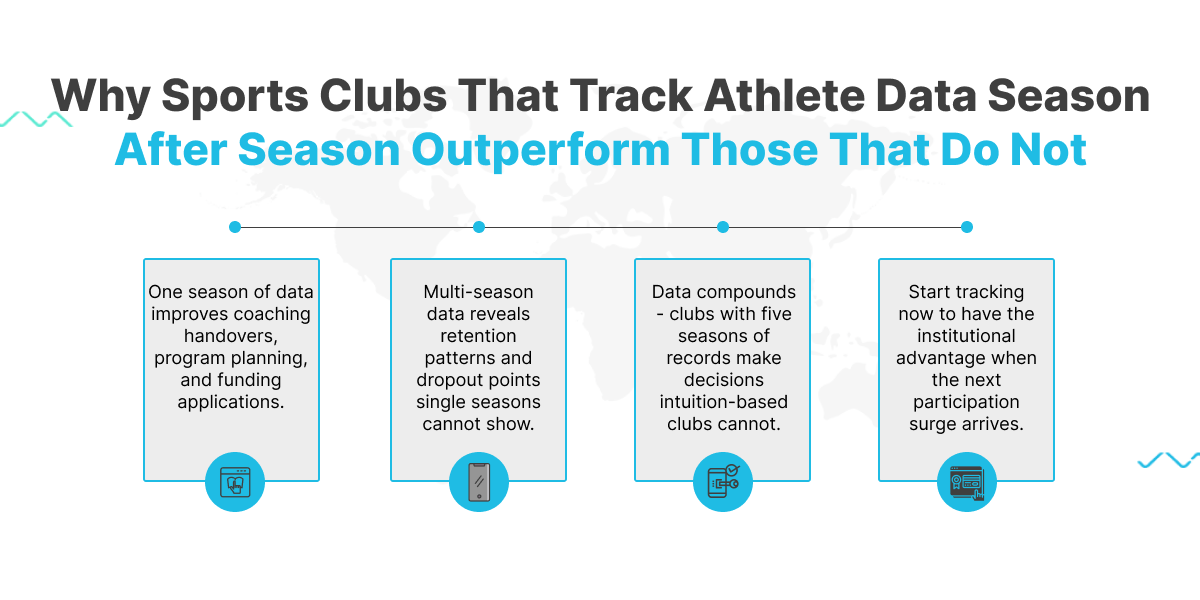 What Multi-Season Data Makes Possible That One Season Cannot
The most powerful capabilities of structured athlete data emerge when it exists across multiple seasons rather than only within one.
Multi-season data makes retention analysis possible. A club with three seasons of data can see exactly how many participants returned from year one to year two, which programs had the strongest re-enrollment rates, and at what point in the development pathway the dropout rate was highest. These patterns are invisible in a single season’s data but become clear over multiple seasons. Knowing that a disproportionate number of athletes drop out at a specific point in the program allows the club to investigate why and make targeted improvements.
Multi-season data makes curriculum effectiveness visible. If the same skill consistently shows low completion rates across multiple seasons and multiple coaches, that is strong evidence that either the teaching approach needs to change or the criteria need to be adjusted. If completion rates on the same skill improve after a curriculum change, the data shows that the change worked. Single-season data cannot establish either of these things with confidence because there is no baseline to compare against.
Port Credit Yacht Club demonstrated this over time. The club used Checklick to address challenges with retaining young sailors and reversing a slide in adult enrollment. After implementing progression displays and custom registration questions, the club could track how participants discovered the club, see where each athlete stood in the program pathway, and use that data to inform marketing and resource allocation. The outcome was greater transparency, data-driven insights, and improved retention. The key is that this kind of strategic use of data is only possible when the data has been systematically collected in a consistent format over time. Read the Port Credit Yacht Club success story
Multi-season data also makes funding applications significantly stronger. Funders who want to see sustained impact, not just a good year, need trend data across multiple seasons. A PSO or NSO that can show progression rates improving year over year, retention increasing as program design has been refined based on data, and participant demographic reach growing consistently is making a fundamentally stronger funding case than one presenting a single season’s results.
How the Data Advantage Compounds Over Time
The compounding effect of multi-season data works as follows. In year one, you collect baseline data. You see what happened. In year two, you compare against the baseline. You start to see trends. In year three, you have enough data to identify patterns with confidence and to show that the program improvements you made based on year two data actually worked.
By year five, you have a historical picture of your programs that no newcomer to the market can replicate. You know which programs consistently produce strong development outcomes and which ones have struggled. You know which cohorts of athletes tend to stay and which tend to drop out. You know how your membership demographics have shifted over time and whether your programs are reaching the communities you intend to serve.
This institutional knowledge, grounded in data rather than memory, is a genuine competitive advantage. It allows you to make better decisions than clubs operating on intuition. It allows you to demonstrate your effectiveness to funders more credibly than clubs submitting narratives. And it allows you to support athletes more precisely than clubs that start fresh every season. See how Checklick’s Evaluation Marketplace supports program tracking at scale
Why Starting Now Matters
The clubs that will have five seasons of data in 2031, when the FIFA Women’s World Cup comes to North America and the next major participation surge drives families into youth sports programs, are the ones that started collecting structured athlete data in 2026. The clubs that wait until 2028 or 2029 will have two or three seasons of data. The clubs that start now will have five.
That difference is not just a data quantity difference. It is an organizational maturity difference. The clubs that have been tracking systematically for five seasons have built the operational habits, coaching practices, and administrative infrastructure that produce consistently useful data. They do not have to figure out how to start collecting data in the middle of a crisis. It is already happening as a natural byproduct of how they operate.
Checklick is an all-in-one Athlete Development Tracking System and Sports Club Management System rated 4.7 on GetApp and Software Advice. It is used by hundreds of clubs across Canada and Ireland. The evaluations platform starts at fifteen dollars per month for clubs with under fifty evaluators. The Storefront charges 4.9% per transaction with no monthly fees. Both come with a thirty-day free trial. See Checklick’s full pricing
Frequently Asked Questions
Why does multi-season athlete data provide a bigger advantage than single-season data?
Single-season data shows you what happened in one year. Multi-season data shows you patterns, trends, and the impact of program changes over time. Retention analysis, curriculum effectiveness measurement, and trend-based funding reporting all require at least two to three seasons of consistent data to be meaningful.
How does athlete tracking data improve member retention?
Multi-season data allows clubs to identify at which point in the development pathway dropout is most common and to investigate and address the cause. Combined with end-of-season communication that uses specific evaluation data to give families a forward-looking reason to re-enroll, structured data is one of the most effective retention tools available.
What does structured athlete data look like in a funding application?
Structured funding data includes participation numbers broken down by demographic characteristics, skill completion rates by program level, multi-season progression trends, and an audit trail confirming the data is accurate and complete. Funders increasingly prefer organizations that can provide this kind of evidence over those that submit narrative descriptions alone.
How long does it take to start seeing the benefits of structured athlete tracking?
The first season of data provides immediate benefits for program planning, coach transitions, and single-season funding reporting. The compounding advantages of multi-season data analysis begin to emerge clearly from the second and third seasons onward.
Start your free trial at checklick.com and begin building the data foundation that your club’s long-term growth depends on.
