

Safeguarding in youth sports is most commonly discussed in terms of coach conduct, supervision policies, and complaint procedures. These are genuinely important elements of a youth-safe sports environment. But there is a dimension of safeguarding risk in sports clubs that receives far less attention and that is directly connected to how clubs handle registration and payment.
That dimension is the handling of cash by children and young people.
When sports clubs collect registration fees in cash, and many still do, the process often involves children carrying significant sums of money to and from training sessions or club events. It involves young people handling money in informal settings without proper supervision or record-keeping. And it creates a situation where missing payments, lost cash, or mishandled funds can create conflicts and accusations that are damaging to everyone involved.
This is not a theoretical risk. It is a documented concern that sport governing bodies, child protection organizations, and sport insurers have flagged specifically in relation to cash handling in youth sport environments. And it is one that the right registration infrastructure eliminates completely.
You can read about how to modernize your club’s registration infrastructure more broadly in our earlier blog on how sports clubs can improve member retention without spending more on marketing
Why Cash Handling Is a Safeguarding Issue in Youth Sport
The connection between cash handling and safeguarding may not be immediately obvious, so it is worth being specific about why sport protection bodies take it seriously.
The first concern is the direct risk to children who are asked to carry cash. A child who brings a registration fee in cash to a sports session is carrying money in an environment with other children, in transit on public transport or on foot, and in circumstances where it can be lost, stolen, or mishandled. Placing that responsibility on a child creates risk that responsible adults in the organization should be carrying instead.
The second concern is the opportunity for adult misconduct. When cash changes hands informally in sports settings, without formal receipts, proper accounting, or transparent records, it creates opportunities for financial misconduct by adults in positions of trust. Children in youth sports programs are inherently in a power-dependent relationship with coaches and club administrators. Informal cash handling within that relationship reduces visibility and accountability in ways that can create risk.
The third concern is the dispute risk when payments are lost or disputed. When a family claims they paid a registration fee in cash and the club has no record of receiving it, or when a club claims a family has not paid and the family disputes this, the result is a conflict that implicates the adult-child relationship in ways that can be damaging and difficult to resolve.
Barrie Yacht Club in Ontario identified this problem directly when it reviewed its registration practices. The club’s previous registration system required payment by cheque, which posed several risks including minors handling large sums of money and misplaced payments. The situation created real concern within the club about the appropriateness of the process and the risks it created for young members. After transitioning to Checklick’s Storefront, registration moved to a clean online flow with credit card payment required at the point of registration. The risks associated with children handling money were eliminated immediately. Payment records were automatically maintained with no possibility of dispute over whether payment was received. Read the Barrie Yacht Club success story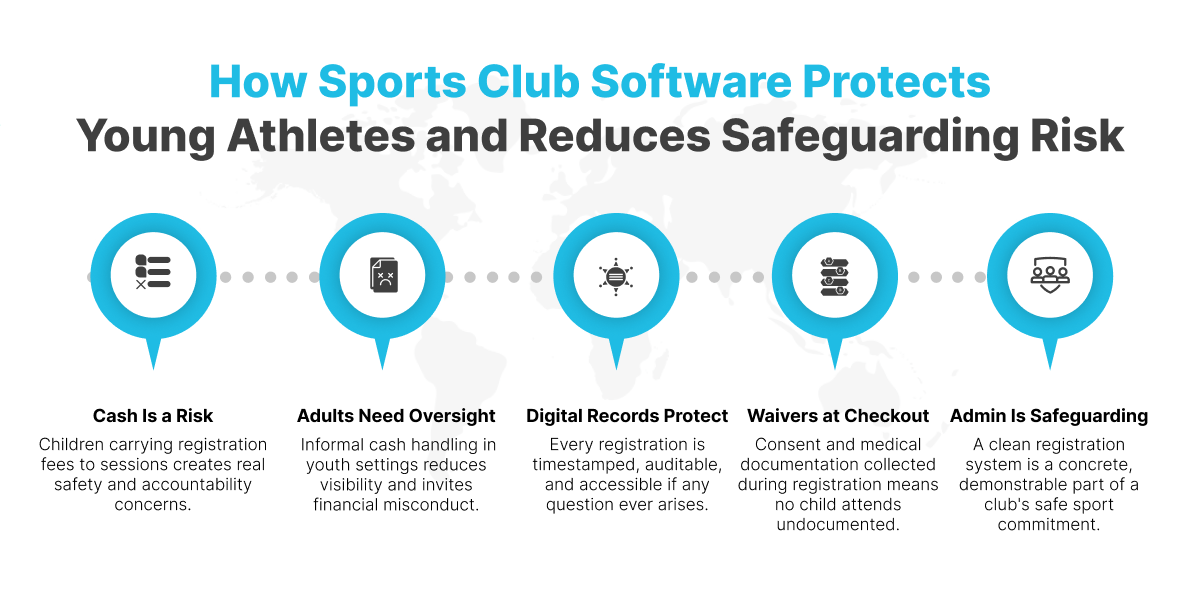 What Transparent Digital Records Do for Accountability
Beyond eliminating cash handling, digital registration systems improve safeguarding through the transparency and accountability they create around participation records.
When every registration is completed through a digital platform, the club has a complete, timestamped record of who registered for every program, when they registered, who collected their payment, and what information was provided during the registration process. This record is accessible to authorized administrators at any time and cannot be altered without leaving a trace.
This level of record-keeping matters for safeguarding in several ways. It means the club always knows exactly who is enrolled in each program, which is fundamental to knowing who should and should not be on the premises during a session. It means that parent and guardian contact information is captured accurately at registration and is immediately accessible if it is needed in an emergency. And it means that if any question ever arises about a child’s participation, payment, or circumstances at any point during the season, the record is there and verifiable. See how Checklick’s Storefront creates transparent registration records
For organizations that are subject to the Canadian Sport Governance Code or that operate under the Safe Sport policies of national governing bodies, this kind of transparent, auditable record-keeping is part of demonstrating that the club is taking its child protection obligations seriously.
Waivers and Consent Documentation in Digital Registration
A complete safeguarding registration process includes not just payment but also the collection of consent documentation, medical information, and signed waivers that the club needs before a young person participates in its programs.
When these documents are collected on paper separately from the registration process, clubs face a persistent tracking problem: they need to know, before every session, that every participant has a signed waiver and complete medical information on file. Managing this manually creates situations where children show up to participate without the required documentation, placing the club in a difficult position.
Checklick’s Storefront includes waiver collection as part of the online checkout flow. A completed registration means a signed waiver and all required consent documentation have been submitted and are stored in the platform. Before any session, the administrator can see immediately that every enrolled participant has completed the full registration including all required documentation. There is no separate paper tracking required and no possibility of a participant attending without complete documentation. See how Checklick’s Storefront handles waivers and registration in one flow
The Registration System as Part of a Broader Safe Sport Culture
It would be an overstatement to suggest that moving to online registration is sufficient to address all safeguarding concerns in a youth sports club. Safe sport requires policy, culture, training, and oversight that go well beyond any software tool.
But the registration and payment system is a meaningful component of a club’s overall safeguarding infrastructure. Eliminating cash handling removes a specific, documented risk. Digital record-keeping improves transparency and accountability. Integrated waiver and consent collection ensures that required safeguarding documentation is complete for every participant before the season begins.
These are concrete, achievable improvements that any club can make by adopting the right registration platform. And they demonstrate to parents, governing bodies, and funders that the club takes its child protection obligations seriously in every aspect of its operations, including the administrative ones.
Checklick’s Storefront charges 4.9% per transaction with no monthly fees. A thirty-day free trial is available. Phone and email support is available including weekends. See Checklick’s full pricing
Frequently Asked Questions
Why is cash handling a safeguarding concern in youth sports?
Cash handling in youth sports places financial responsibility on children, creates risk of loss or theft, reduces financial transparency and accountability, and can create disputes between families and club staff that implicate the adult-child relationship in damaging ways. Sport protection organizations flag this as a specific safeguarding risk in youth sport settings.
How does digital registration reduce safeguarding risk?
Digital registration eliminates cash handling by requiring payment through the online checkout. It creates transparent, auditable payment records. It integrates waiver and consent collection so all required documentation is complete before participation begins. And it maintains accessible participation records that support accountability and emergency response.
Does the Canadian Sport Governance Code require specific record-keeping standards for youth sport clubs?
The Code establishes expectations for transparency, accountability, and effective governance for national and provincial sport organizations. Clubs affiliated with governing bodies that operate under the Code are expected to demonstrate appropriate administrative practices including transparent participant records and safe payment processes.
Can waiver collection be integrated into the online registration process?
Yes. Checklick’s Storefront includes waiver collection as part of the checkout flow. A completed registration means a signed waiver and all required consent documentation have been submitted, with no separate paper tracking required.
Start your free trial at checklick.com and make your club’s registration process part of its broader commitment to safe sport.
