

Every August, thousands of families across Canada finish their children’s summer sports programs and start thinking about what comes next. Some of them will look for a fall program at the same club they attended all summer. Others will make different plans. And the difference between which families return and which ones do not is almost never about whether they enjoyed the summer program.
It is about whether the club gave them a specific, compelling reason to come back.
Summer programs are natural entry points. They capture families who are motivated by the season, the weather, and in 2026, the elevated youth sport participation interest that the summer created. But entry points are only valuable if they lead somewhere. A family that had a good summer experience with your club has positive feelings about it. Positive feelings alone do not produce fall enrollment. A specific, evidence-based reason to continue does.
This blog covers what separates the clubs that convert their summer participants into fall members from the ones that lose them in the six weeks between the last summer session and the first fall communication. If you want to understand how athlete tracking connects to fall retention specifically, our earlier blog on how youth soccer clubs can build a development pathway that keeps players engaged after the World Cup covers that connection in detail.
Why Positive Summer Experiences Do Not Automatically Produce Fall Enrollment
A family whose child had a positive summer program experience has one thing working in your favor: they feel good about the club. That is genuinely valuable. It means the default disposition toward returning is positive rather than neutral or negative.
What it does not provide is a reason to act. Feeling good about an experience is a background state. Making an enrollment decision requires something more active: a specific prompt, a clear next step, a forward-looking reason to commit time and money to a continuation.
Most clubs communicate at the end of summer with a general thank-you and a link to fall registration. This communication relies entirely on the positive feeling to do the work. It assumes that families who had a good summer will naturally follow through on enrollment when reminded that fall exists.
Many of them will not. Not because the summer was not good but because the thank-you email arrived during a busy August week when they were already thinking about school supplies, back-to-school schedules, and the fifty other decisions that August brings for families with children. The email was read, the link was not clicked, and by the time the family thought about sport again, they had made other plans.
The clubs that consistently convert summer participants into fall members do not rely on the positive feeling to do the work. They give families something specific to act on: a clear picture of what their child accomplished over the summer, a named next step in the development pathway, and a direct enrollment opportunity with a deadline that creates enough urgency to produce action.
What the Conversion Window Actually Looks Like
The window for converting summer participants into fall members is narrower than most clubs realize. It opens in the final week of summer programs and closes approximately four to six weeks later when families have settled into fall routines and made their activity decisions for the season.
Within that window, there are specific moments when families are most receptive to a fall enrollment conversation. The first is at the end of the last summer session, when the experience is freshest and the emotional connection to the club is strongest. This is the moment for a direct, specific conversation about what comes next: not a generic “we hope to see you again” but a specific “your child has completed Level 2 this summer and is ready for Level 3 in September.”
The second moment is the week after the summer program ends. Families are still thinking about sport because the routines that the summer program created have not yet been replaced by new ones. A communication that arrives during this week, while the memory is fresh and the habit is still present, lands very differently than the same communication sent three weeks later, once other activities have started filling the space sport used to occupy.
The third moment is the early registration incentive window, when early bird pricing or a program filling up creates urgency for families who have been meaning to register but have not yet taken action.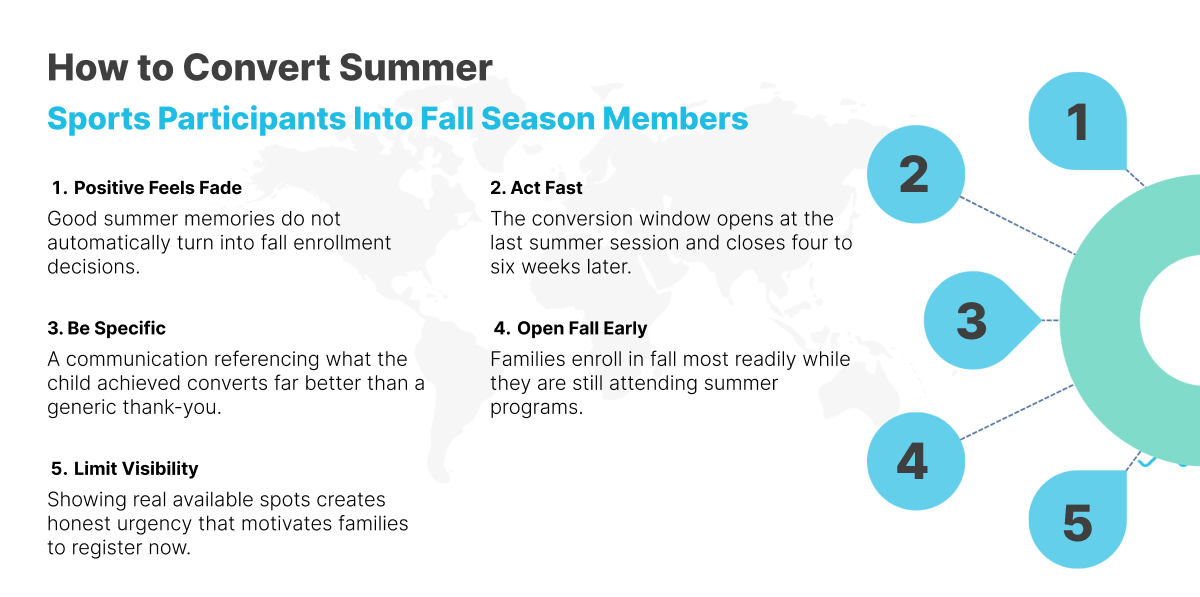
The Data That Makes These Conversations Specific
The reason most clubs cannot have specific, forward-looking conversations with summer participants about fall is that they do not have the data to make those conversations specific. They know that the family attended. They do not have a clear picture of where the child ended up developmentally, what they are ready for next, or what specifically they accomplished over the summer.
When athlete development is tracked digitally throughout the summer, all of that information exists in a centralized system at the end of the program. Administrators can see exactly where each athlete completed the summer, which skills they achieved, which level they are ready for in fall, and what the next program in their pathway looks like.
Port Credit Yacht Club used exactly this capability to address retention challenges. The club needed to retain young sailors after their first seasons and reverse a slide in adult program enrollment. After adopting Checklick, staff used the platform’s built-in progression displays to show parents exactly where each participant stood in the program pathway. The outcome was greater transparency for families and boosted confidence in the club’s long-term pathway. That transparency directly supported the club’s retention goals by giving families a concrete, specific reason to continue rather than a general impression that the summer went well.
Four Practical Steps to Improve Summer-to-Fall Conversion
The first step is making fall registration available before summer ends. Families who are in the habit of attending your programs are most receptive to enrolling in the next one while they are still actively attending the current one. If fall registration is not open during the final weeks of summer, you are missing the highest-conversion window in your calendar.
The second step is communicating specifically at the end of summer. Instead of a generic thank-you, send each family a communication that references what their child specifically accomplished. What level did they complete? What skills did they demonstrate? What program are they ready for next? This specificity requires athlete tracking data, but it produces a fundamentally more persuasive communication than anything generic can achieve.
The third step is making fall enrollment as easy as summer enrollment was. If a family had a good experience with your summer registration process, replicating that experience for fall enrollment removes the friction that causes motivated families to defer. Checklick’s Storefront allows clubs to have fall programs live and accepting registrations on any device with the same branded, mobile-friendly checkout experience that summer programs used.
The fourth step is setting fall program enrollment limits and making them visible. When families can see that a fall program has limited spots and some are already taken, the urgency to register is natural and honest. Programs that appear to have unlimited availability feel like something that can always be signed up for later. Limited spots with up-to-date availability create a decision moment.
What Fall Retention Actually Looks Like With the Right Infrastructure
The clubs that consistently achieve strong summer-to-fall conversion are not spending more on marketing or sending more communications. They are doing three things consistently. They are tracking athlete development throughout summer so they have specific data to share at the end of the season. They are communicating that data to families in a format that makes the next step clear and compelling. And they are making fall enrollment as friction-free as summer enrollment.
Each of these things requires infrastructure rather than additional effort. Athlete tracking happens automatically as coaches use the platform during sessions. Progress data is available without manual compilation. Fall registration is open and functional without a separate setup process. The effort goes into coaching and program delivery, not into administrative catch-up.
Checklick is an all-in-one Athlete Development Tracking System and Sports Club Management System used by hundreds of clubs. The evaluations platform starts at fifteen dollars per month for clubs with under fifty evaluators. The Storefront charges 4.9% per transaction with no monthly fees. Both come with a thirty-day free trial.
Frequently Asked Questions
When is the best time to open fall sports registration?
The highest-conversion window for fall registration is during the final two to three weeks of summer programs, when families are still actively participating and most likely to commit to continuing. Waiting until September means missing the families who made their fall plans in August.
What makes end-of-season communication effective for fall retention?
Effective end-of-season communication is specific to each athlete’s progress rather than generic. Telling a family exactly what their child accomplished in summer and what they are ready for in fall gives them a forward-looking reason to enroll rather than a general positive feeling that may not produce action.
How does athlete tracking data support fall re-enrollment?
When athlete development is tracked digitally throughout summer, administrators can see exactly where each athlete finished the season, which level they are ready for next, and what the fall program pathway looks like. This data powers specific, personalized end-of-season communications, which give families a concrete reason to act instead of a generic reminder they can put off.
What is the most common reason summer participants do not return in fall?
The most common reason is not dissatisfaction with the summer program. It is that the club did not give families a specific, timely, forward-looking reason to commit to fall before they made other plans in August.
Start your free trial and make sure your summer participants have a clear path into your fall programs.
