

Most National Sport Organizations (NSOs) and Provincial Sport Organizations (PSOs) that struggle to secure or maintain critical high-performance funding do not have a talent problem. They have a documentation problem.
Funders, government grant committees, and Olympic oversight bodies all require clear evidence that development programs work before allocating resources. A well-phrased mission statement about sporting excellence or a general description of a daily training environment is no longer sufficient. Decision-makers look for objective, measurable results. They need reliable data demonstrating exactly how athletes progress through the development pathway, what skill thresholds they achieve, and how the organization’s high-performance strategy makes a verified impact.
For NSOs that track athlete progression systematically, providing this evidence is straightforward. The data sits ready within a centralized registry, allowing administrators to generate comprehensive reports in minutes to back up their funding requests.
However, for organizations relying on disconnected spreadsheets, paper records, or fragmented coach logs, answering a funding body’s technical inquiries requires weeks of manual labor. This approach routinely produces inconsistent, incomplete metrics that fail to withstand strict auditing.
This gap is precisely what separates sports organizations that predictably protect their funding from those that consistently fall short.
The Evolution of Sport Funding: Moving Beyond Raw Participation
High-performance sport funding has undergone a significant structural shift. Historically, sports governing bodies could secure funding primarily by reporting raw participation numbers — essentially showing a high headcount of registered participants.
Today, the landscape is entirely different. Funding frameworks favor evidence-based models. Oversight bodies are moving away from surface-level registration numbers and are instead mandating high-quality, verifiable athlete development data.
In Canada, organizations like Own the Podium (OTP) base their funding recommendations on rigorous, data-driven performance analysis and athlete pathway metrics. NSOs must provide comprehensive insights into their daily training environments, sport science integration, and next-generation athlete progression to demonstrate long-term podium potential.
Similarly, in the United States, the U.S. Olympic & Paralympic Committee (USOPC) works alongside National Governing Bodies (NGBs) to evaluate detailed high-performance plans. Resources, services, and high-performance grants are funneled directly to the sports that present the strongest data-backed blueprints for sustained competitive outcomes and pipeline health.
What Modern Funding Committees Look For
To meet the strict evaluation criteria of organizations like Own the Podium or the USOPC, sports governing bodies must track specific, multi-layered development metrics across the entire national or provincial pipeline:
Pathway Transition and Retention Rates: Funding committees examine the conversion rate of athletes moving from grassroots to provincial tracks, and ultimately into the high-performance pipeline. Is the athlete pathway retaining talent over multi-year cycles, or is there a drop-off in the development chain?
Skill Progression Frameworks: Grant reviewers require proof of structural skill mastery. What percentage of the current athlete pool meets specific technical benchmarks established by the national curriculum?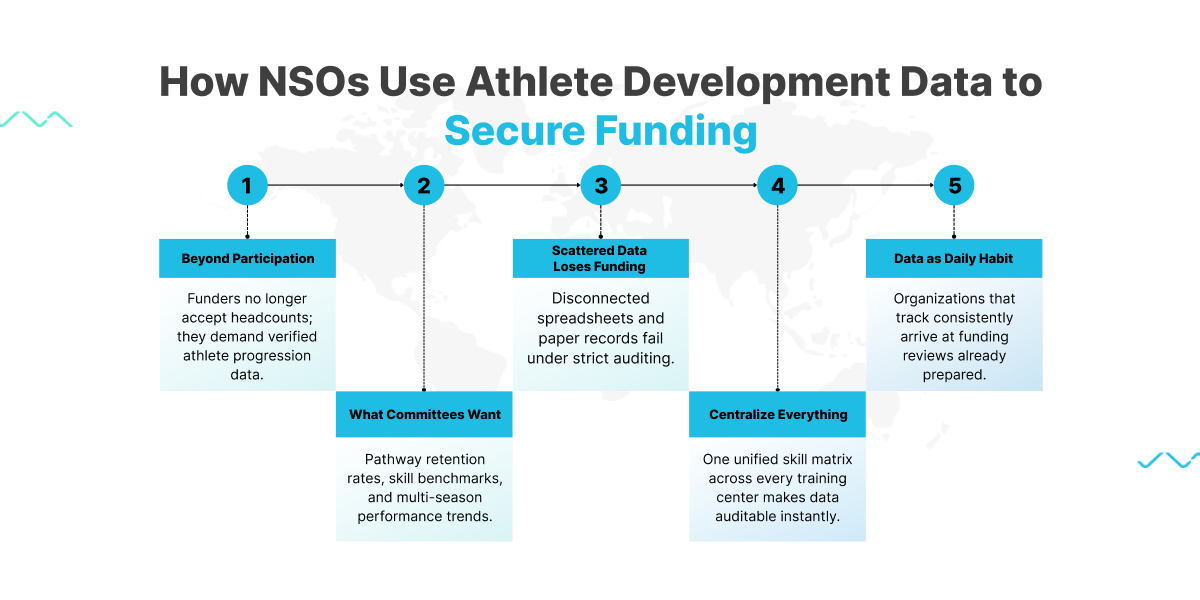
Long-Term Athlete Development Alignment: Is the training structurally appropriate for the developmental stage of the athletes? Funding bodies require data validating that coaches nationwide adhere to uniform, standardized development models rather than inconsistent training protocols.
Multi-Season Performance Trends: Examiners prioritize sustainable, long-term impact over a single standout competitive season. They analyze whether technical benchmarks are improving year-over-year across the entire organization, signifying a healthy, repeatable training ecosystem.
For NSOs utilizing Checklick’s structured athlete tracking and reporting tools, this entire data pipeline is centralized. High-performance directors and administrators can instantly aggregate nationwide skill completion rates, age distribution demographics, and long-term progression trends without sorting through disconnected files.
Why Scattered Tracking Systems Undermine Credibility
The reason many sports organizations struggle to compile compelling data for high-performance reviews is rarely a lack of on-field results. Instead, it is that those results are rarely captured in a reportable, auditable format.
When regional clubs, provincial coaches, and national scouts use different grading systems, paper sheets, or localized spreadsheets, standardization breaks down. The data becomes only as reliable as the individual coach maintaining the file. This creates fragmented records, subjective grading criteria, and no viable way for the NSO to aggregate data across multiple training centers or competitive seasons.
By the time a crucial funding review or grant deadline arrives, administrators find themselves trying to manually reconstruct an entire season’s worth of athlete progression from scattered sources. This results in a weaker funding submission than the organization deserves, simply because the data story is incomplete and difficult for external auditors to verify.
The NSOs that consistently protect and grow their funding solve this challenge early. They do not just focus on writing better grant proposals; they build a solid data foundation throughout the year so the empirical evidence is already waiting when review season arrives.
Streamlining National Evaluations with Centralized Software
Building an auditable data foundation requires standardizing the evaluation process across every tier of the sport’s infrastructure.
- Centralize the Performance Matrix
The national technical committee must establish a unified skill matrix directly aligned with official development tiers (such as gymnastics levels, sailing standards, or customized high-performance benchmarks). Every training center must utilize the exact same rubric.
- Deploy Real-Time Mobile App Evaluations
Coaches need the ability to log technical evaluations instantly at trackside, poolside, or on the field via mobile devices. By removing paper, evaluation data flows immediately into a central registry.
- Generate Instant System-Wide Reports
With all regional training data funneling into a singular dashboard, national administrators can monitor the health of the entire athlete pathway in real time, pulling comprehensive, multi-season reports for funding partners at a moment’s notice.
The Reality of Large-Scale Sport Operations
One prominent organization utilizing Checklick manages over 500 active participants through the platform simultaneously. For entities operating at this scale, relying on manual data compilation introduces significant operational risk. The ability to generate accurate, verified, and system-wide athlete development reports on demand is a core requirement for remaining fundable.
Securing the Future of Your Sport
The organizations that secure the most substantial, sustainable high-performance backing are those that treat data collection as a natural part of daily training rather than an emergency task triggered by a grant deadline.
When coaches evaluate athletes as part of their standard session routine, and that data automatically aggregates into a centralized, secure system, the administrative overhead drops significantly. Administrators remain prepared for high-stakes funding conversations with stakeholders, government partners, and corporate sponsors alike.
Checklick’s centralized evaluation platform scales to support national and provincial frameworks, offering custom skill matrices, secure database management, and robust reporting engines built explicitly for sport governance.
Ensure your organization’s talent matches its data. Learn how to centralize your high-performance tracking and protect your development pipelines at checklick.com.
