
What Is Athlete Development Tracking and Why Does Your Club Need It?
If you run programs at a sports club, you are already doing some version of athlete development. Your coaches are teaching skills. Athletes are improving. Programs are running season after season. The question is not whether development is happening. The question is whether you actually know how much, and whether you have a reliable way to use that information to get better.
That is what athlete development tracking is for.
This blog explains what athlete development tracking actually means, why it matters for sports clubs of every size, and what happens when clubs commit to doing it properly.
What Athlete Development Tracking Is
Athlete development tracking is the process of recording, measuring, and reviewing how athletes are progressing through the skills and levels in your programs. It is not just about scoring athletes or ranking them against each other. It is about creating a clear, consistent record of where each person is in their development so that coaches can make better decisions, programs can be improved, and families can see the value of what their club is delivering.
At its simplest, athlete development tracking answers three questions. Where is this athlete right now? Where were they at the start of the season, or the start of last season? And are they developing at the rate we expect them to?
When you can answer those questions consistently and confidently for every athlete in your program, you are doing athlete development tracking well. When you are relying on memory, informal notes, or scattered spreadsheets, you are not.
Why Most Clubs Do Not Track Development Properly
The reason most sports clubs do not have proper athlete development tracking in place is not that they do not care about development. It is that tracking has historically been either too complicated or too time-consuming to do consistently.
Paper-based tracking requires someone to collect forms, store them, and later try to make sense of what they contain. Spreadsheet-based tracking requires coaches to update files manually and then somehow get those files to administrators who need the data. Neither system scales beyond a small program without becoming a significant burden.
So most clubs settle for informal tracking. Coaches remember who is progressing. Skill levels get discussed at the end of season. Development happens, but it is not measured, not recorded, and not connected to any process for improving programs over time.
The cost of this is bigger than it looks. When development is not tracked, programs do not improve in a structured way. Parent retention suffers because families cannot see their child’s progress clearly. Coaches who leave take their knowledge with them. And clubs that apply for funding have a hard time demonstrating program impact with real data.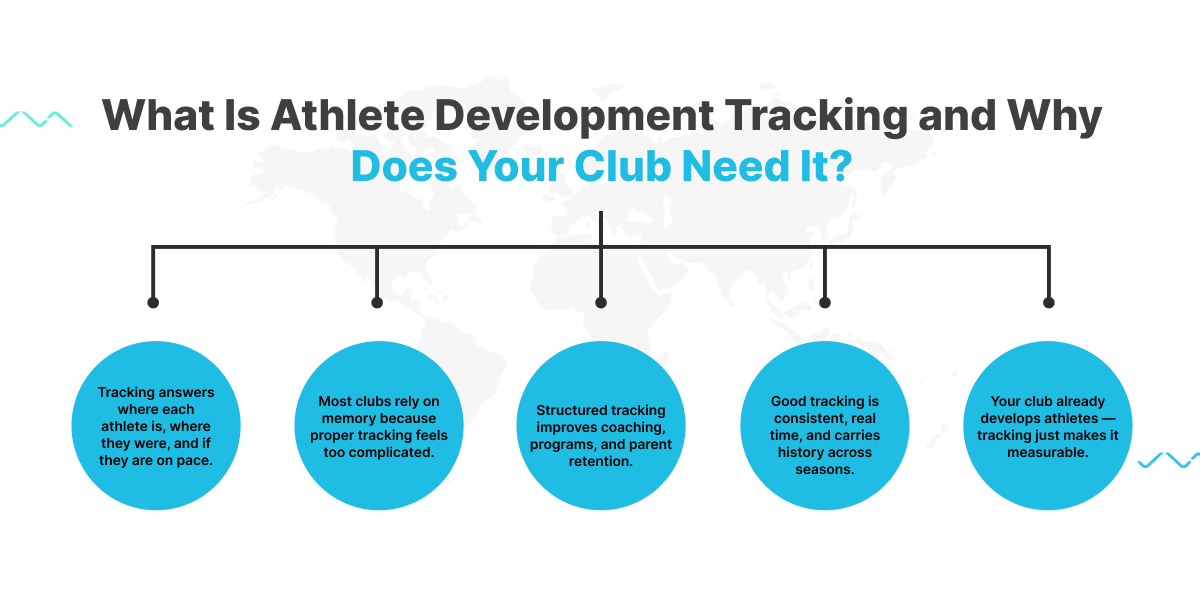
What Changes When You Track Athlete Development
When a sports club commits to structured athlete development tracking, several things shift at once.
Coaching becomes more intentional. When a coach has a clear record of where each athlete stands, session planning becomes much more focused. Instead of running the same drills for everyone and hoping the right athletes improve, coaches can target their work based on what the data shows. The athletes who need more time on a particular skill get it. The ones who are ready to move forward do.
Programs improve season over season. The clubs that track development properly are the ones that get measurably better every year. When you have data on how athletes progressed through your program, you can see where the gaps are. Maybe a specific skill is consistently incomplete at the end of the season. Maybe athletes at one level are advancing faster than those at another. That information tells you where your program needs attention. Without it, you are guessing.
Retention improves because parents stay engaged. One of the most important but least discussed benefits of athlete development tracking is what it does for parent relationships. Parents who can see clearly how their child is progressing are far more likely to re-enroll the following season. Port Credit Yacht Club used Checklick’s built-in progression displays to show parents exactly where each participant stood in the program pathway. The outcome was greater transparency for families and boosted confidence in the club’s long-term pathway. That kind of visibility is a retention tool as much as it is a coaching tool.
What Good Athlete Development Tracking Looks Like
Good athlete development tracking has a few essential qualities.
It is consistent. Every coach is evaluating athletes against the same criteria. There is no variation in how skills are assessed from one instructor to another. When standards are consistent, progress is meaningful. When they are not, comparisons between athletes or across seasons are unreliable.
It is accessible. The data does not sit on one person’s laptop or in a filing cabinet that requires a key. Administrators can see program-level data. Coaches can see their athletes’ history before every session. Parents can see their child’s progress without having to ask. Checklick centralizes all of this in one platform so everyone who needs the information has it without anyone having to manually compile or distribute it.
It is real time. When a coach evaluates an athlete during a session, that evaluation should be available immediately. Not at the end of the week when someone gets around to updating a spreadsheet. Checklick lets coaches evaluate athletes on their phone or tablet right on the field or in the water, and that data flows into the system instantly. Administrators have an up-to-date picture of program progress at any point in the season, not just at the end of it.
It carries forward. One of the most valuable things athlete development tracking does is preserve development history across seasons and across coaches. When a new instructor joins your club, they should be able to see exactly where every athlete in their group left off. That continuity is only possible when tracking is digital, centralized, and structured. Checklick maintains each athlete’s development record over time, so nothing gets lost when seasons end or staff changes.
Who Needs Athlete Development Tracking
A common misconception is that athlete development tracking is only for large organizations or elite programs. In reality, the clubs that benefit most from it are often the mid-sized and smaller ones that are trying to grow and improve without adding significant staff or overhead.
If your club runs programs for youth athletes across multiple skill levels, you need structured tracking. The development pathways are multi-season, the coaches change, and the parents expect to see their children moving forward in a visible way.
If your club relies on any form of external funding, you need structured tracking. Funders want evidence that your programs are working. Age distribution, skill completion rates, and progression data are exactly the kind of statistics that demonstrate program impact. Checklick’s reporting tools make it possible to pull that data without hours of manual work.
If your club licenses programs to other training centers, or wants to, you need structured tracking at scale. Checklick is the only system to easily manage the licensing of programs to training centers, which means organizations deploying their curriculum beyond their own facility can track development data across their entire network in one place.
And if your club simply wants to keep more members from season to season, tracking athlete development is one of the most direct ways to do it. Families stay when they can see their child growing. They leave when development feels invisible.
How to Get Started
Starting with athlete development tracking does not require a perfect system or a long implementation process. It requires a clear set of skills for your coaches to evaluate and a platform that makes recording those evaluations easy enough that coaches will actually do it.
Checklick lets you build custom skill matrices for your programs, deploy them to coaches across your club, and start collecting evaluation data immediately. The platform is built for sports clubs specifically, so the workflow fits how coaches and administrators actually work rather than asking them to adapt their routines to a generic tool.
The evaluations platform starts at fifteen dollars per month for clubs with under fifty evaluators. There is a thirty-day free trial so you can see how it fits your club’s programs before committing to anything long term.
Your Club Is Already Doing Development. Start Tracking It.
Every program your club runs is already developing athletes in some way. Coaches are teaching skills. Athletes are learning. Progress is happening. The only question is whether your club is capturing any of that in a way that helps you improve, retain members, and prove the value of what you do.
Athlete development tracking is what turns informal coaching into a system that gets better every season. It is what keeps parents engaged and coming back. And it is what gives clubs the data they need to grow with confidence instead of guesswork.
Start your free trial at checklick.com and see how straightforward it is to build a tracking system that actually works for your club.