

Long Term Athlete Development, known as LTAD, is one of the foundational frameworks of Canadian sport. It was developed through Canadian Sport for Life, or CS4L, and it defines how sport programs should be structured at each stage of a young person’s development from first sport experience through to lifetime participation or high-performance competition.
Most coaches in Canada have heard of LTAD. Most sport organizations reference it in their program descriptions. Most funding applications to Sport Canada and provincial sport funding bodies invoke it as the framework within which programs are delivered.
But ask most clubs and even many PSOs how they know their programs are actually aligned with LTAD principles, and the answer is usually some version of “our coaches are trained on it.” Training on a framework is not the same as demonstrating alignment with evidence. And in an environment where funders are increasingly asking for data rather than declarations, the difference between these two things is becoming harder to ignore.
This blog explains what LTAD actually requires of sport programs, why demonstrating alignment is harder than describing it, and how digital athlete tracking makes LTAD alignment measurable rather than assumed. You can also read about how PSOs can standardize evaluation across their affiliate networks in our blog on how PSOs and RSOs can standardize athlete evaluation across all affiliated clubs
What LTAD Actually Requires of Sport Programs
The Long Term Athlete Development framework identifies several stages of physical literacy and athletic development through which participants progress across their sport lives. In community sport, the most relevant stages for most clubs and PSOs are Active Start, FUNdamentals, and Learn to Train, which together cover the early years of sport participation for children from early childhood through early adolescence.
Each stage has specific physical development objectives, appropriate training-to-competition ratios, and skill development priorities. A program that claims LTAD alignment is claiming that its design and delivery match these stage-specific objectives: that it is teaching the right skills at the right developmental stage, that it is balancing training and competition appropriately, and that it is supporting healthy long-term development rather than early specialization.
The problem is that none of these things can be verified without data. You cannot demonstrate that your program is teaching age-appropriate skills to age-appropriate athletes without records of what skills are being taught, to whom, and at what stage of their development. You cannot show that athletes are progressing through the expected developmental stages without evaluation records that document that progression. And you cannot prove that your coaching approach aligns with LTAD principles without systematic data on what is actually happening in sessions. See how Checklick’s evaluation platform captures athlete development data
Why Most Clubs Cannot Prove LTAD Alignment
The gap between claiming LTAD alignment and proving it comes down to data capture. Most clubs that operate LTAD-aligned programs do not have systems in place to record what is actually happening in their programs in a way that produces auditable evidence of alignment.
Coaches are trained on LTAD and they apply that training in their sessions. But unless their session planning, their athlete evaluations, and their program outcomes are recorded in a structured, centralized system, the evidence of LTAD alignment exists only in the coaches’ practices, not in any format that an external reviewer can verify.
When a funder asks for evidence of LTAD alignment, the honest answer from most clubs is that their coaches are trained on it and they believe they are applying it correctly. This is not the same as showing a funder a dataset that demonstrates which athletes were at which developmental stage, which age-appropriate skills they worked on, how they progressed through those skills across the season, and how that progression compares with the expected trajectory for their LTAD stage.
Grapple Yukon Association and Northern Lights Judo Club in Yukon, Canada ran into a version of this problem before adopting Checklick. Operations relied on manual records that were difficult to access remotely, particularly challenging given that administrator Dan Poelman frequently travelled for work. Historical data could not be retrieved without being physically present with the records. After adopting Checklick, historical data became instantly accessible from anywhere. The platform centralized registration and membership tracking, made it accessible from any device, and supported automated reports and certificates that significantly reduced manual administration. The outcome was not just convenience. It was the ability to demonstrate program history and participant records to any stakeholder at any time. Read how clubs like Grapple Yukon are using Checklick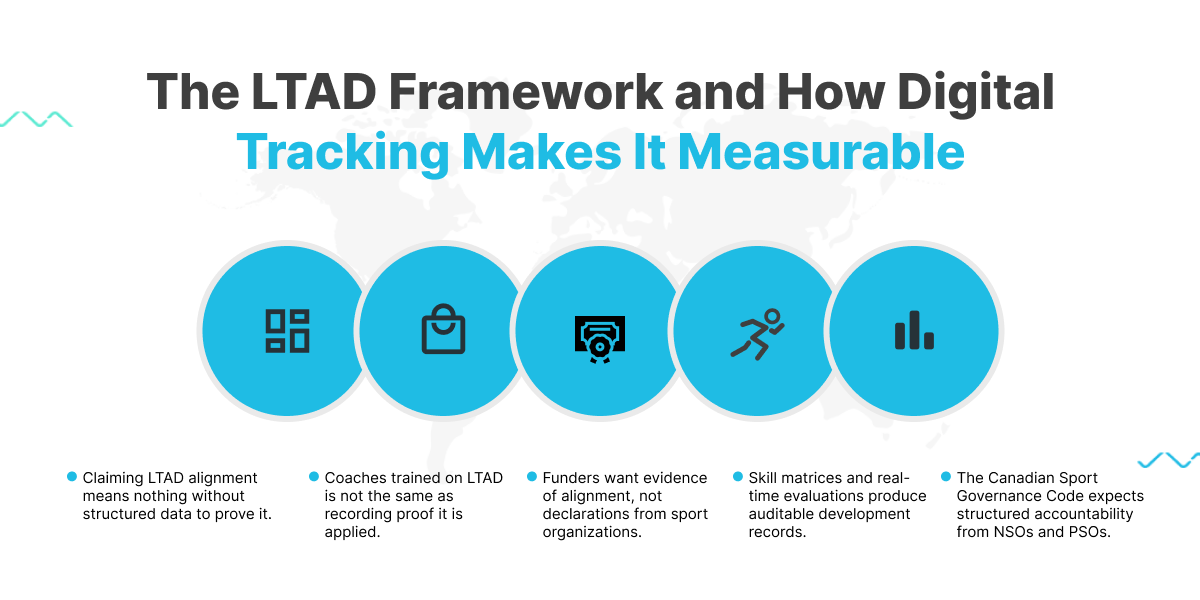
What Digital Athlete Tracking Adds to LTAD Program Delivery
When athlete evaluation is recorded digitally in a structured platform rather than on paper or in informal coach notes, it produces the evidence of program delivery that LTAD alignment claims require.
Checklick allows clubs to build custom skill matrices for each program, organized by the developmental stage and skill priorities appropriate to that program. Coaches evaluate athletes against those criteria using their phones or tablets during sessions. The evaluations are recorded in real time and flow into a centralized system that administrators can report on at any point during or after the season. See how Checklick’s skill matrices and evaluation tools work
This data infrastructure produces several things that manual systems cannot. It produces a record of which skills were evaluated in each session, with dates and coach attribution. It produces an individual progression record for each athlete showing how they advanced through the program’s skill criteria across the season. And it produces aggregate program data showing completion rates, progression rates, and demographic breakdowns that can be reported to funders without manual compilation.
For a PSO or NSO that needs to demonstrate LTAD alignment to Sport Canada or a provincial funding body, this data is the difference between claiming alignment and evidencing it. The claim and the evidence may ultimately describe the same program. But funders increasingly want the evidence, and the clubs and PSOs that can provide it are in a materially stronger position than those that cannot. See how Checklick’s Evaluation Marketplace supports program licensing and data collection at scale
LTAD and the Canadian Sport Governance Code
The Canadian Sport Governance Code establishes expectations for transparency, accountability, and effective management for national and provincial sport organizations. Demonstrating that programs are designed, delivered, and evaluated in alignment with established frameworks like LTAD is part of meeting those accountability expectations.
Organizations that can provide structured, centralized, auditable program data are better positioned to meet the Code’s expectations than those that operate on institutional knowledge and informal records. Digital athlete tracking is not just a program management convenience. It is part of building the governance infrastructure that Canadian sport funders expect of serious provincial and national organizations.
Checklick is used by hundreds of sports clubs across Canada and Ireland and is rated 4.7 on GetApp and Software Advice. It is an all-in-one Athlete Development Tracking System and Sports Club Management System designed specifically for the needs of sport development organizations from the community club level to the provincial and national governing body level.
Frequently Asked Questions
What is Long Term Athlete Development (LTAD)?
LTAD is a framework developed through Canadian Sport for Life that defines how sport programs should be structured at each stage of a participant’s development, from early childhood through to lifetime participation or high-performance sport. It guides decisions about what skills to teach at each developmental stage and how to balance training with competition.
Why is LTAD alignment a funding requirement for Canadian sport organizations?
Sport Canada and provincial sport funding bodies use LTAD alignment as one criterion for evaluating whether sport organizations are delivering programs that support healthy, long-term athlete development. Programs that can demonstrate LTAD alignment with data are better positioned in funding applications than those that only reference the framework.
How does digital athlete tracking demonstrate LTAD alignment?
Digital tracking systems like Checklick allow clubs to build skill matrices that reflect LTAD-appropriate developmental objectives and record athlete evaluations against those criteria throughout the season. The resulting data provides a structured, auditable record of what skills were taught to which athletes at which developmental stage.
What is the difference between CS4L and LTAD?
Canadian Sport for Life (CS4L) is the organization that developed and promotes the Long Term Athlete Development (LTAD) model in Canada. LTAD is the framework itself. CS4L provides resources, research, and advocacy to support implementation of the LTAD principles across Canadian sport.
Start your free trial at checklick.com and start producing the evidence of LTAD alignment that your programs deserve.
