

Every athlete who competed at the 2026 Milan-Cortina Winter Olympics earned their spot through a qualification process. Not through reputation, not through a coach’s opinion, not through a general sense that they seemed ready. They qualified because they met specific, documented, verifiable standards. Their results were on record. Their credentials were not in question. The standards existed, the athletes met them, and the system confirmed it.
This is exactly the same logic that underpins certification-based sports programs at the club level. Whether a club runs CANSail progressions, judo belt progressions, wrestling skill tiers, or any other structured certification framework, the fundamental mechanism is identical to the Olympic qualifying process. Athletes demonstrate specific competencies. Those competencies are evaluated against defined criteria. And a record is created that confirms the athlete has met the standard.
The question most sports clubs need to ask themselves is not whether they believe in this standard. Most do. The question is whether their current system is actually upholding it.
What Certification Standards Are Actually For
Certification standards in youth and amateur sports exist for several interconnected reasons. They protect athletes by ensuring they are not placed in environments or activities beyond their current skill level. They protect organizations by creating a documented record of where each athlete stands. They protect coaches and instructors by giving them a shared language for athlete readiness. And they protect the integrity of the program itself by ensuring that advancement means something real.
When certifications are tracked informally, all of these protections weaken. If a coach leaves and takes their mental model of which students are at which level with them, the club has a problem. If a parent contests an assessment and the club has no documented evidence to point to, the club has a problem. If a regional body or national organization asks for certification records and the club cannot produce them reliably, the club has a much bigger problem.
Certification tracking is not paperwork for its own sake. It is the infrastructure that makes a program credible, safe, and defensible.
The Olympic Standard Applied to Club-Level Sport
Consider what the Olympic qualification system actually does. It creates a verifiable record that an athlete has met a defined threshold. It is consistent across organizations and geographies, meaning the standard means the same thing regardless of where it was assessed. It is accessible to the relevant parties – the athlete, the coach, the governing body – and it persists across time. You can look up an Olympic qualifier’s result years later and know exactly what it means.
This is the standard that club-level certification programs aspire to. The goal is not to recreate the complexity of the Olympic qualification process. It is to capture the essential logic: documented, consistent, accessible, persistent. That is what digital certification tracking provides.
Clubs that have adopted digital certification management report that the shift changes the way their programs feel both internally and externally. Instructors know exactly what each athlete has completed and what comes next. Families receive digital certificates that confirm their child’s achievement in a professional format. Program coordinators can access certification records for any participant at any point in the season without digging through filing cabinets.
Why Sailing and Judo Clubs Have the Most to Gain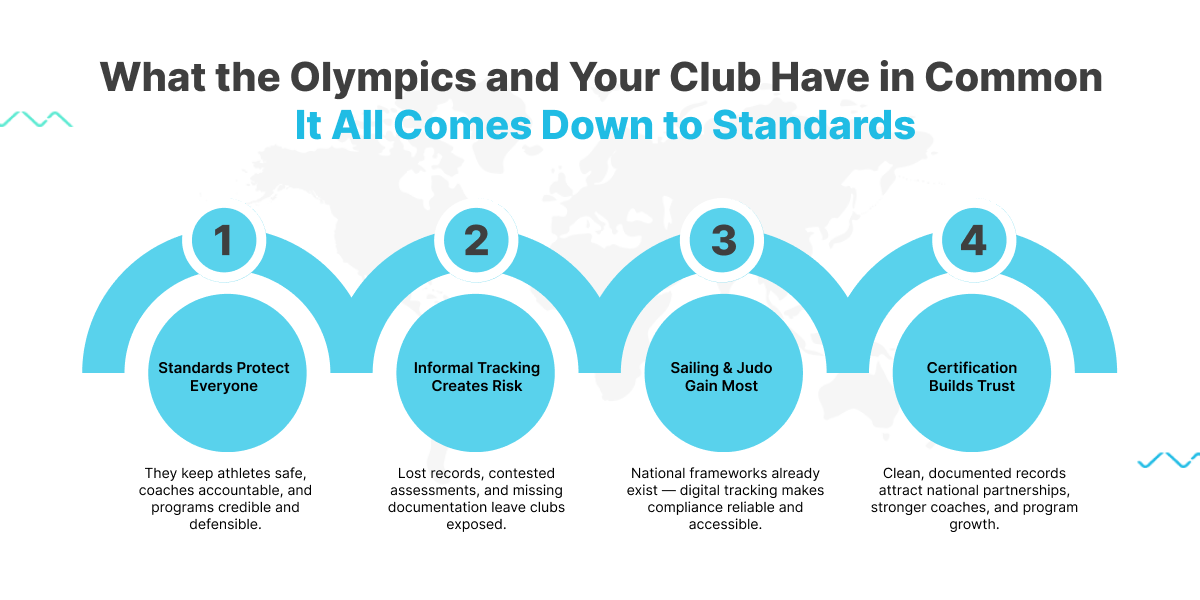
Sports that operate within national certification frameworks – sailing clubs following CANSail levels, judo clubs following their national grading structure – have a particular reason to prioritize digital certification tracking. These frameworks already exist. The standards are already defined. The only variable is whether the club is documenting compliance with those standards in a way that is reliable and accessible.
For a sailing club running CANSail-aligned programs, this matters at the level of individual athlete safety and program credibility. When a sailor advances to a more demanding class or takes on a coaching role, their certification record needs to be unambiguous. For a judo club issuing gradings, the same principle applies. The certification is only as credible as the process that produced it.
Checklick was developed in close partnership with Sail Canada to manage CANSail certifications and has been recognized for certification tracking excellence within that framework. This is not a general-purpose tool adapted for sports. It is a platform with direct, documented expertise in the specific certification challenges that sailing clubs face, with the same structural logic applicable across other sports that operate within certification frameworks.
Building a Club That Organizations & Members Trust
There is a competitive dimension to certification standards that clubs sometimes overlook. When a national sports organization evaluates which clubs to partner with, which programs to endorse, or which facilities to recommend to participants, certification integrity is a meaningful factor. A club that can demonstrate clean, accessible, well-documented certification records is a club that national organizations can work with confidently.
This is especially relevant for clubs that aspire to grow their programs, to license their curriculum to other facilities, or to attract higher-level coaching staff who want to work within a credible structure. The infrastructure of certification tracking is also the infrastructure of institutional credibility.
Checklick allows clubs to instantly update skill checklists, monitor certification usage, and track athlete performance across all aspects of a program through a single platform. Clubs with fewer than 50 evaluators can access this capability at $15 per month with a 30-day free trial. For larger organizations, a managed services package provides implementation support and consulting alongside the platform itself.
The Olympics remind us every four years that standards matter and that achievement means something only when the process that produced it is credible. Your club has the same opportunity to build that credibility, one properly documented certification at a time.
Explore Checklick’s certification tracking capabilities at checklick.com. Start your 30-day free trial today.
