

Athlete evaluation is one of the most important functions in any sports development program. It is how coaches document progress, how parents understand their child’s development, and how organizations maintain standards across programs and seasons. Yet evaluation is also one of the most neglected processes in club operations – not because coaches do not care, but because the tools historically available to them were tedious, disconnected, and impractical to use in the actual coaching environment.
Mobile-first athlete evaluation changes this. By putting evaluation tools directly on the device coaches already carry – their phone or tablet – the process becomes something that happens in real time, during practice, at the waterfront, or on the mat. This is not a minor convenience improvement. It is a fundamental shift in how evaluation data gets created, shared, and used.
The Problem With Traditional Evaluation Methods
Traditional athlete evaluation typically follows one of two patterns. In the first, coaches carry paper checklists or binders to practices and events, making notes as they observe athletes. These notes are later transcribed – if they are transcribed at all – into a spreadsheet or database. In the second pattern, evaluation happens entirely at the end of the season or program, relying on the coach’s memory to reconstruct months of observations into a final assessment.
Both approaches have obvious flaws. Paper-based evaluation creates a bottleneck between observation and documentation. Notes get lost, handwriting is illegible, and the transcription step introduces errors and delays. End-of-season evaluations compress an entire season of development into a single retrospective assessment that inevitably misses nuance and detail.
The deeper problem is adoption. When evaluation requires extra steps – especially steps that happen away from the coaching environment – coaches deprioritize it. They are there to coach, and anything that pulls them away from that primary function gets pushed to the bottom of the to-do list. Many coaches view traditional evaluation processes as administrative overhead rather than a coaching tool.
What Makes Evaluation Mobile-First?
Mobile-first evaluation means the evaluation system was designed from the ground up to be used on a phone or tablet. This is different from a desktop application that has a mobile version. Mobile-first design means the interface, workflow, and interaction patterns are optimized for the smaller screen, touch input, and the on-the-go context in which coaches operate.
Checklick’s evaluation platform is built around this principle. Coaches can use their phone or tablet to evaluate participants as they progress through programs. The platform enables clubs to create customized skill matrices for their programs and track athlete progress through a user-friendly interface designed for mobile accessibility.
This means a sailing instructor on the dock can open Checklick, pull up a student’s evaluation, and check off demonstrated skills in real time. A judo coach can update an athlete’s belt progress between rounds on the mat. The evaluation happens where the coaching happens, eliminating the gap between observation and documentation.
Why Mobile-First Drives Coach Adoption
The single biggest factor in whether an evaluation system succeeds is whether coaches actually use it. A platform with every feature imaginable is worthless if instructors avoid it because it is cumbersome or time-consuming.
Mobile-first evaluation drives adoption because it fits into the existing coaching workflow rather than creating a separate administrative workflow. Coaches do not have to set aside time after practice to transcribe notes. They do not have to remember to bring a specific binder or clipboard. They simply use the device that is already in their pocket.
Starlight Sailing Adventures provides a practical example. Before using Checklick, admin work was time-consuming and disjointed. After implementing the platform, instructors access it to view up-to-date class lists and record student progress directly. The platform gave instructors real-time access to class rosters, eliminating the disconnect between administration and instruction.
West Hawk Lake Yacht Club reported a similar experience. Before Checklick, instructors lacked easy access to updated participant lists. After implementation, instructors got instant access to updated class lists. The software’s improved functionality on mobile devices, particularly iPhones, made on-the-go management easier, and improved mobile usability led to fewer participant complaints.
The Skill Matrix Approach
Effective mobile evaluation depends on having a well-structured framework for what is being evaluated. Checklick uses customizable skill matrices that clubs can tailor to their specific programs.
A skill matrix defines the specific competencies athletes should demonstrate at each level of a program. Rather than asking coaches to write free-form assessments, the matrix provides a structured checklist of observable skills. This structure makes mobile evaluation fast – a coach can check off skills as they observe them – while maintaining consistency across different instructors and sessions.
Clubs can create custom skill matrices tailored to their program for effective athlete performance management. This means a wrestling program’s skill matrix will look completely different from a sailing program’s CANSail framework, but both use the same platform and the same mobile-first evaluation workflow.
Real-Time Progress for Parents and Athletes
One of the most powerful outcomes of mobile-first evaluation is the immediacy of progress updates. When coaches evaluate athletes in real time, parents and athletes do not have to wait until the end of the season to see how development is progressing.
Checklick enables clubs to keep participants, their parents, and coaches engaged in every step of their skill development. The platform promotes athlete development through mobile accessibility and effective data management. Frequent athlete evaluation promotes communication and ongoing development for players, coaches, and parents by tracking progress, setting goals, and recognizing accomplishments.
Port Credit Yacht Club leveraged this capability directly. Using Checklick’s built-in progression displays, staff now show parents exactly where each participant stands in the program pathway. This transparency is valuable for parent retention – when families can see concrete progress, they are more likely to re-enroll in subsequent seasons.
Digital Certifications
Mobile-first evaluation also streamlines the certification process. When evaluation data is captured digitally in real time, generating certifications becomes automatic rather than manual.
Starlight Sailing Adventures reported that all evaluation and certification processes are now handled digitally through Checklick. The platform centralized records, supported audit trails, and ensured compliance with Sail Canada standards. This eliminated the need for separate certification paperwork at the end of a program – the evaluation data collected through mobile use throughout the season serves as the basis for certification.
Checklick enables clubs to send progress reports and certificates directly through the platform. This means that when an athlete completes the requirements for a certification level, the documentation is already in the system. There is no transcription step, no separate certification form, and no delay.
The Integration Advantage
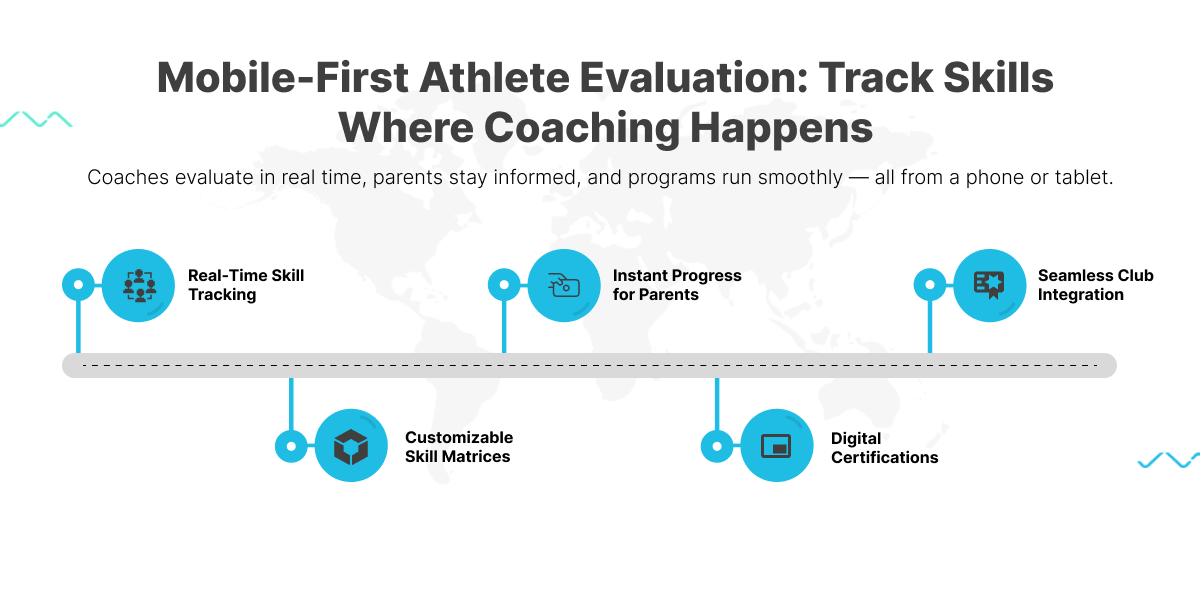
Mobile-first evaluation delivers the most value when it is integrated with the rest of the club’s operations. When evaluation is connected to registration data, the coach does not have to manually create an evaluation record for each student – it already exists from the registration. When evaluation is connected to the storefront, families registering for the next level can see what certifications their child has already achieved.
Checklick’s platform connects evaluations with its storefront, licensing, and management features. This creates a continuous workflow: a family registers through the storefront, their child’s evaluation record is active from day one, the coach evaluates in real time using mobile tools, progress is visible to parents throughout the season, and certifications are generated automatically upon completion.
Choosing a Mobile-First Evaluation Platform
When evaluating platforms for mobile-first athlete evaluation, the key questions are practical. Can you actually use it on your phone in the coaching environment? Is the interface designed for quick, one-handed interaction? Does it support customizable skill matrices for your specific sport? Can instructors view class rosters and evaluation records from the same mobile interface? Does it generate certifications from evaluation data automatically?
Checklick addresses each of these requirements with a platform rated 4.7 on Software Advice, designed specifically for sports clubs and instructors. The system simplifies every aspect of club management through an intuitive interface that coaches can adopt quickly.
The shift to mobile-first evaluation is not just a technology upgrade. It is a fundamental improvement in how athlete development gets documented, communicated, and sustained across seasons.
Ready to put evaluation tools in your coaches’ hands? Start your 30-day free trial at www.checklick.com.
