

Every sports club starts somewhere – usually with a handful of dedicated volunteers, a shared email account, and a lot of improvisation. Paper registration forms get photocopied. Payments come in as cash or checks. Evaluation notes are jotted in binders. Waivers are collected at the door on the first day of the program.
This approach works when your club has a dozen participants. But it does not scale. And the cost of maintaining manual processes grows in ways that many club administrators do not fully recognize until they are deep into the consequences.
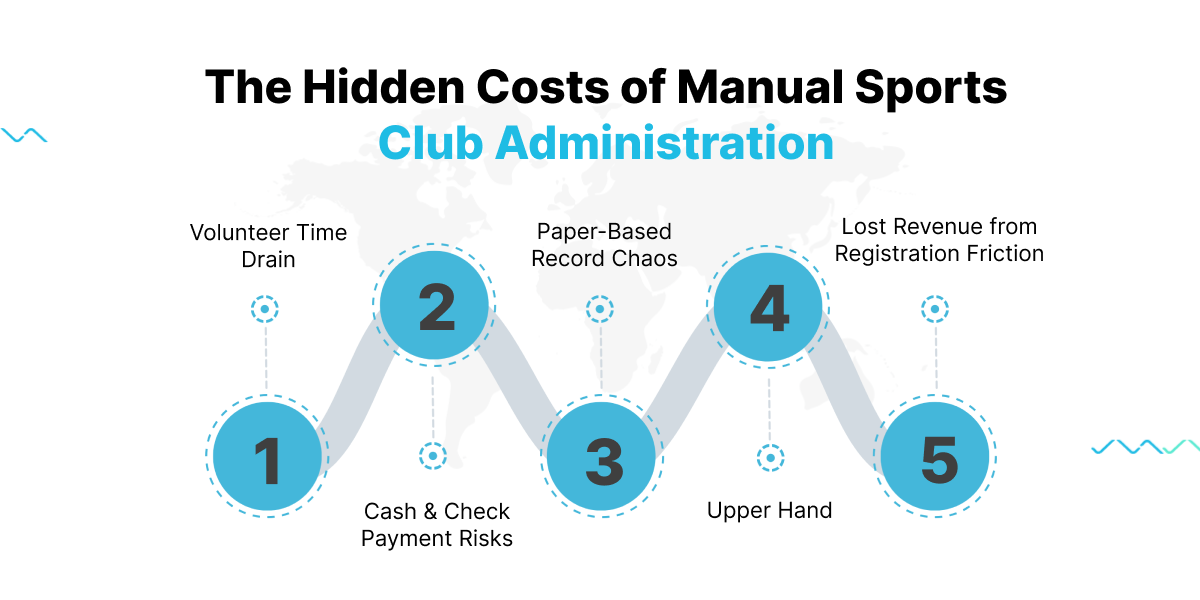
This is not about the direct cost of paper and ink. The real cost of manual administration shows up in volunteer burnout, lost revenue, compromised safety records, limited program growth, and an inability to demonstrate organizational credibility.
The Time Tax on Volunteers
The most immediate cost of manual administration is time – specifically, volunteer time. Sports clubs, particularly those operating at the community level, depend almost entirely on unpaid labor to manage operations. When those operations are manual, the time required to handle basic tasks expands dramatically.
The Gimli Yacht Club experienced this firsthand. Before adopting digital tools, program organizers handled signups through email, and payments were typically made by cash or check – often not collected until after the program had ended. Each registration required a manual confirmation, and many members would register verbally in person, making it difficult to track commitments. Chasing down registration fees stretched well into the fall, adding strain to the administration process.
After transitioning to Checklick, the results were measurable. Volunteers save an estimated 15 minutes on each registration. With 80 participants, the club saves roughly 20 volunteer hours per year. The sailing program has expanded since implementing Checklick, and a single, streamlined system now handles all registrations efficiently.
Twenty hours may not sound dramatic in isolation. But for a volunteer-run club where every hour of administrative work competes with time that could be spent coaching, maintaining equipment, or simply spending time with family, 20 hours is significant. That is two and a half full working days of volunteer labor redirected from chasing paperwork to supporting the actual mission of the club.
The Cash and Check Problem
Cash and check payments create a cascade of operational problems that most clubs accept as normal until they experience the alternative.
West Hawk Lake Yacht Club relied on cash collection before adopting digital tools. Applications and waivers were filled out manually, and registration fees were collected in cash. Administrative tasks were performed without the benefit of remote access or digital records, making coordination more difficult.
Barrie Yacht Club initially collected payments by check, which posed several risks, including minors handling large sums of money and misplaced payments. When they switched to another system before Checklick, it introduced new problems such as manual data entry, difficult refund processes, and unreliable discount handling.
Port Dover Yacht Club also dealt with the reality that cash payments were slow and risky. The club needed a better solution that could handle payment processing alongside registration and program management.
The costs of cash and check handling include delayed revenue collection, the risk of lost or misplaced payments, the administrative burden of manual reconciliation, the inability to issue efficient refunds, and – in some cases – actual safety concerns when young volunteers handle significant amounts of money.
Lost Institutional Knowledge
When club administration depends on one person’s memory, filing system, or personal email account, the organization is one resignation away from chaos. Manual processes rarely include documentation about how things work – they exist in the heads of the people who created them.
This is particularly problematic in seasonal sports clubs where volunteer turnover is common. Each season brings new administrators who must figure out how the previous person handled registrations, where evaluation records are stored, and which families have outstanding payments.
Digital systems solve this by creating persistent, accessible records that survive personnel changes. Checklick stores all registration data, evaluation records, payment histories, and certification information in a centralized platform that any authorized administrator can access. This means the transition from one season’s volunteer coordinator to the next does not require a box of files and a two-hour orientation – the information is already in the system.
The Impact on Instructor Effectiveness
Manual administration does not just affect the people managing the club. It directly impacts instructors and coaches on the ground.
Before adopting Checklick, instructors at West Hawk Lake Yacht Club lacked easy access to updated participant lists. This meant they could not efficiently prepare for classes, track individual progress, or communicate updates to parents. After implementing the platform, instructors got instant access to updated class lists through real-time access features.
Starlight Sailing Adventures had a similar experience. Admin work was time-consuming and disjointed, with increased seasonal pressure to fill classes in a short time. Booking calendars were scattered across platforms and email threads, and instructor availability had to be confirmed manually for each course. After implementing Checklick, instructors access the platform to view up-to-date class lists and record student progress directly.
When instructors spend their time tracking down rosters instead of coaching, athlete development suffers. That is a cost that does not show up on any spreadsheet but has a direct impact on program quality.
Registration Friction and Lost Revenue
Every point of friction in the registration process is a potential lost enrollment. When families have to fill out paper forms, write checks, and hand-deliver waivers, some will not complete the process – not because they do not want to participate, but because the process is inconvenient.
Port Dover Yacht Club demonstrated what happens when that friction is reduced. After implementing Checklick’s storefront for registration, their new two-week program sold out and saw high demand. Registration became faster and more streamlined, reducing time and effort for both families and staff.
Checklick’s Storefront allows clubs to have a payment and registration system for customers in less than an hour. The storefront supports courses, memberships, event tickets, and merchandise. It is optimized for any screen size, including computers, tablets, and mobile phones. Customers can make purchases for multiple people and multiple products, and a real-time preview of the customer’s order total updates automatically.
When registration is easy, more families complete it. When payment is immediate, revenue collection is no longer a season-long chase.
Certification and Compliance Risk
For clubs operating within national certification frameworks, manual record-keeping creates compliance risk. If an organization cannot demonstrate that certifications were properly evaluated and documented, the credibility of those certifications – and the organization itself – is compromised.
Starlight Sailing Adventures addressed this directly by adopting Checklick to manage their Sail Canada certifications. The platform centralized records, supported audit trails, and ensured compliance with national standards without additional manual effort. All evaluation and certification processes are now handled digitally.
The alternative – maintaining paper records of who achieved which certification, when, and who evaluated them – is inherently fragile. Papers get lost, filing systems vary between volunteers, and there is no efficient way to verify certification status across multiple seasons without manually searching through archives.
Quantifying the Real Cost
Most clubs do not calculate the true cost of manual administration because the labor is volunteer-based. But that does not mean the cost is zero. Consider what 20 hours of recovered volunteer time means to a club like Gimli Yacht Club – time that can now go toward program development, facility maintenance, community outreach, or simply reducing volunteer fatigue.
Consider what sold-out programs mean for a club like Port Dover Yacht Club, where reduced registration friction led directly to higher enrollment in new programming.
Consider what professional presentation means for a club like West Hawk Lake Yacht Club, which reported that smoother operations built trust, even if revenue impact was indirect. The club appeared more organized and credible to participants.
The real cost of manual administration is not any single line item. It is the accumulated weight of inefficiency that prevents clubs from growing, retaining volunteers, and delivering the best possible experience to their athletes and families.
The Path to Digital Operations
Transitioning from manual to digital club management does not require a massive budget or technical expertise. Checklick offers a 30-day free trial that gives clubs access to the full platform. The $15/month evaluator package for organizations with fewer than 50 evaluators means even the smallest clubs can afford the transition. And the Storefront’s 4.9% per-transaction model means there is no upfront cost for payment processing.
Hundreds of sports clubs have already made this transition. One verified reviewer noted it was their sixth season using Checklick and called it an extremely helpful utility. The question for clubs still operating manually is not whether to transition – it is how much longer they can afford not to.
Ready to eliminate manual administration? Start your 30-day free trial at www.checklick.com
