

Running a sports club in 2026 demands more than passion and good coaching. Between registrations, payments, athlete evaluations, certification tracking, and parent communication, the administrative side of club operations has become a full-time job — one that most volunteer-driven organizations simply cannot staff. Sports club management software exists to solve that exact problem, and the platforms available today have evolved far beyond basic scheduling tools.
This guide breaks down what modern sports club management software actually looks like, what features matter most, and how to evaluate platforms so your club can spend less time on paperwork and more time developing athletes.
What Is Sports Club Management Software?
At its core, sports club management software is a digital platform that centralizes the administrative tasks involved in running a sports organization. This includes registration and payment processing, athlete progress tracking, certification management, communication with parents and coaches, and program scheduling.
The most effective platforms in 2026 go further. They combine what was traditionally handled by separate tools — a registration system here, a spreadsheet tracker there, an email chain somewhere else — into a single, unified system.
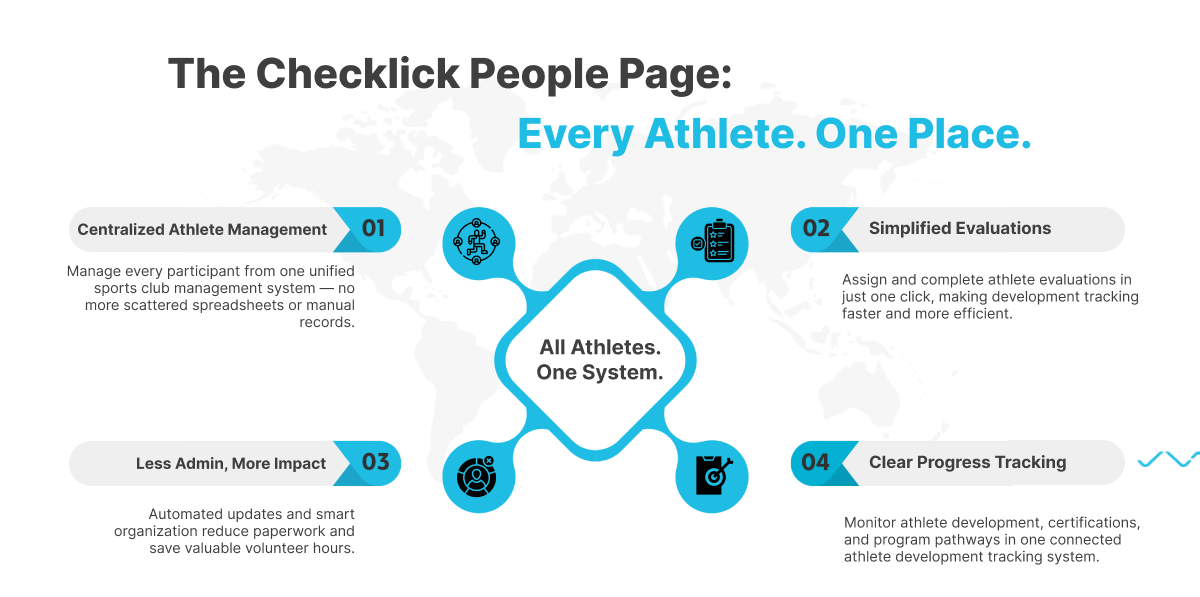
Checklick, for example, is an all-in-one Athlete Development Tracking System (ADTS) and Sports Club Management System (SCMS). Rather than piecing together disconnected tools, clubs using Checklick manage evaluations, sell courses and memberships through an integrated storefront, license programs to training centers, and track athlete certifications — all from one platform. It simplifies athlete progress tracking, program evaluation, and club management, helping clubs save time and effort while keeping participants, parents, and coaches engaged.
Why Sports Clubs Need Dedicated Software
Many clubs still operate with a patchwork of manual processes. Registration forms come in via email. Payments arrive as cash or checks. Evaluation records live in binders or spreadsheets that only one person knows how to navigate. Certification tracking depends on someone remembering to update a document at the end of each season.
This approach creates real problems. The Gimli Yacht Club managed registrations manually before adopting digital tools. Program organizers handled signups through email, and payments were typically made by cash or check — often not collected until after the program had ended. Each registration required a manual confirmation, and many members would register verbally in person, making it difficult to track commitments. The result was that chasing down registration fees stretched well into the fall, adding unnecessary strain to administration.
Similarly, West Hawk Lake Yacht Club relied heavily on paper-based methods. Applications and waivers were filled out manually, and registration fees were collected in cash. Administrative tasks were performed without remote access or digital records, making coordination more difficult. Instructors lacked easy access to updated participant lists, which reduced operational efficiency and added unnecessary workload for organizers.
These are not unique problems. They are the norm for clubs that have not yet transitioned to dedicated management software.
Core Features to Look For in 2026
When evaluating sports club management software, there are several capabilities that should be considered essential rather than optional.
Integrated Registration and Payment Processing
The registration process should be seamless — from the moment a family discovers your program to the point where payment is confirmed. Look for platforms that allow you to sell courses, memberships, event tickets, and merchandise from a single storefront. The system should support enrollment limits, waiver forms, customizable questions for specific courses, and both opt-in and automatic discounts.
Checklick’s Storefront feature allows clubs to add courses, memberships, events, and products and have a full payment and registration system operational in less than an hour. The platform charges 4.9% of each customer’s purchase amount with no long-term commitments. Customers can make purchases for multiple people and multiple products, with a real-time preview of the order total that updates automatically. The storefront is optimized for any screen size, including computers, tablets, and mobile phones, and branded PDF receipts are automatically emailed to every customer.
Mobile-First Athlete Evaluation
Coaches should not have to carry clipboards and paper checklists. Modern platforms need to support mobile evaluation — meaning coaches can use their phone or tablet to evaluate participants as they progress through programs. The evaluation interface should be user-friendly enough that instructors actually use it consistently, not just during end-of-season reviews.
Checklick enables clubs to create customized skill matrices and interact with parents, coaches, and participants through its mobile-accessible platform. Instructors can view up-to-date class lists and record student progress directly from any device.
Certification and Compliance Tracking
For sports governed by national certification frameworks, digital certification tracking is critical. The platform should maintain complete records of which athletes have achieved which certifications, across multiple seasons and programs.
Starlight Sailing Adventures, a seasonal sailing school in British Columbia, used Checklick to digitize their certification and program management. As a Sail Canada–recognized platform, Checklick enabled them to manage evaluations and certifications in one place, eliminate spreadsheets and paperwork, and ensure compliance with Sail Canada standards without additional manual effort. All evaluation and certification processes are now handled digitally.
Program Licensing Infrastructure
This is where most platforms fall short. If your organization develops training programs that are delivered by multiple clubs or training centers, you need a system that can manage licensing relationships. This includes distributing skill checklists, monitoring usage, tracking athlete performance across all licensed centers, and managing licensing fees and terms.
Checklick is the only system to easily manage licensing of programs to training centers. The platform allows organizations to license skill development programs to an unlimited number of training facilities, set customizable fees and terms, and even enable sub-licensing options for regional partners to expand program reach without additional effort.
Reporting and Analytics
Club administrators need visibility into program effectiveness. Look for platforms that offer data-driven insights — the ability to evaluate program effectiveness, track enrollment trends, and export detailed records. Efficient order management features like searching orders by customer email or name, downloading customer receipts as PDFs, and exporting spreadsheets of all purchase records save significant administrative time.
How to Evaluate Platforms for Your Club
When comparing sports club management software, consider these practical factors.
First, think about your club’s size and structure. A sailing club with 80 participants has different needs than a national sports organization managing hundreds of training centers. The Gimli Yacht Club, with 80 participants, saves roughly 20 volunteer hours per year through centralized digital registration. A national organization licensing programs needs enterprise-level licensing infrastructure.
Second, consider the total cost of operation. Checklick offers tiered pricing: a free 30-day trial to start, a $15/month package for organizations with fewer than 50 evaluators, and managed services packages for larger organizations with 50 or more evaluators. The Storefront operates on a straightforward 4.9% per-transaction model with no long-term commitments.
Third, evaluate the support model. Volunteer-run clubs often need more hands-on guidance during setup. Barrie Yacht Club specifically noted that hands-on customer service and proactive check-ins were key factors in their successful transition.
Fourth, test the mobile experience. If the evaluation tools are not genuinely usable on a phone at the waterfront, on the field, or in the gym, coaches will not use them. West Hawk Lake Yacht Club specifically reported that improved mobile usability on iPhones led to fewer participant complaints.
The Shift From Registration Systems to Complete Club Management
The biggest shift happening in 2026 is the move from thinking about registration as a standalone function to recognizing that registration, evaluation, certification, and program delivery are all connected.
Port Credit Yacht Club adopted this integrated approach. Using Checklick’s built-in progression displays, staff now show parents exactly where each participant stands in the program pathway.
Getting Started
The path to better club management does not require a massive budget or technical expertise. Hundreds of sports clubs trust Checklick to simplify evaluations, sell programs online, and manage athlete development. One verified reviewer shared that it was their sixth season using Checklick to keep track of sailing school registrations and payments, calling it an extremely helpful utility.
The most practical approach is to start with a free trial, explore the features that match your club’s immediate needs, and expand from there. Checklick offers a 30-day free trial that gives you access to the full platform — evaluations, storefront, reporting, and more — so you can evaluate the system with real data before committing.
Whether you run a community sailing club, a judo academy, or a national sports organization, the right management software transforms operations from a burden into a competitive advantage.
Ready to simplify your club’s operations?
Visit www.Checklick.com
