

Athlete certifications represent the formal recognition of skill achievement within a sport. Whether it is a CANSail level in sailing, a belt rank in judo, or a coaching qualification, certifications carry weight – they validate that an athlete has demonstrated specific competencies as evaluated by qualified instructors under recognized standards.
The challenge for sports clubs is maintaining these certification records reliably across multiple seasons, different instructors, and evolving program structures. When a family returns for their third season, the club needs to know exactly what certifications their child holds, when they were awarded, who evaluated them, and what level they should enter next. Getting this wrong wastes coaching time, frustrates families, and undermines the credibility of the certification framework itself.
Digital certification tracking solves this by creating persistent, centralized, verifiable records that survive the natural turnover of seasonal sports club operations.
Why Paper-Based Certification Records Fail
Paper-based certification records are vulnerable to every risk that affects physical documents: they get lost, misfiled, damaged, or simply left in the wrong box when one volunteer coordinator hands off to the next. In seasonal sports clubs, where operations may shut down entirely for months between seasons, the gap between the end of one program and the start of the next is when records are most likely to be lost or become inaccessible.
Starlight Sailing Adventures experienced this challenge directly. Before using Checklick, there was no central system for syncing Sail Canada certifications with participant tracking. Admin work was time-consuming and disjointed, with scheduling and instructor coordination managed manually across scattered platforms and email threads.
For organizations operating within national certification frameworks like Sail Canada’s CANSail system, the stakes are higher. These are not informal progress notes – they are nationally recognized credentials. If a training center cannot demonstrate that certifications were properly evaluated and documented, the integrity of those certifications is compromised.
What Digital Certification Tracking Looks Like
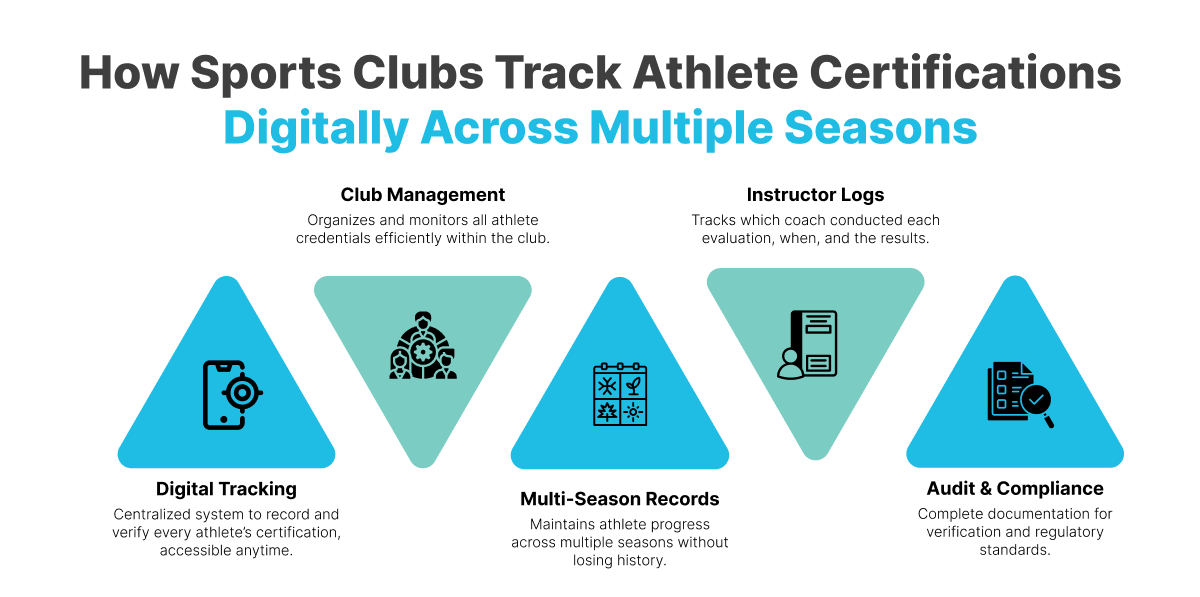
Digital certification tracking means that every certification event – the evaluation, the instructor who conducted it, the date, the skills demonstrated, and the certification awarded – is recorded in a centralized platform that persists across seasons and is accessible to authorized personnel at any time.
Checklick provides this capability as part of its all-in-one platform. The system tracks athlete progress, constructs customized skill matrices, and maintains complete evaluation records that serve as the basis for certification. Coaches can record evaluations in real time using their phone or tablet, and the certification data is immediately available in the system.
Starlight Sailing Adventures adopted Checklick specifically for this purpose. As a Sail Canada recognized platform, Checklick enabled them to manage evaluations and certifications in one place, eliminate spreadsheets and paperwork, and ensure compliance with Sail Canada standards without additional manual effort. The platform centralized records, supported audit trails, and ensured compliance. All evaluation and certification processes are now handled digitally.
Multi-Season Continuity
The most critical aspect of digital certification tracking is continuity across seasons. When all certification data lives in a centralized platform, the transition from one season to the next is seamless. Returning athletes’ records are already in the system. Instructors can immediately see what level each participant has achieved and what skills they demonstrated in previous seasons.
This is particularly important for programs with progressive certification levels. In sailing, for example, the CANSail framework has multiple levels that athletes progress through over multiple seasons. Port Dover Yacht Club deals with changing CANSail levels, new instructors, and growing interest in advanced programming. Without digital records, staff would need to manually verify each returning athlete’s certification status – a time-consuming process that is prone to error.
With Checklick, that verification is immediate. The platform maintains the complete evaluation history, so when a sailor who achieved CANSail 2 last season returns, their instructor already knows their starting point.
Handling Instructor Turnover
Seasonal sports clubs frequently have different instructors from one season to the next. New instructors need access to historical evaluation data to effectively coach returning athletes. Without a digital system, this knowledge transfer depends on whoever ran the program last season being available to explain individual athlete histories – an unreliable process at best.
Port Dover Yacht Club specifically identified yearly onboarding of new instructors as a pressure point. Digital certification records address this by giving new instructors immediate access to the same complete evaluation history that previous instructors maintained.
Checklick supports this by providing real-time instructor access to class rosters, evaluation records, and certification data. When Starlight Sailing Adventures implemented the platform, instructors gained the ability to access the platform to view up-to-date class lists and record student progress directly. This real-time access means new instructors are never working from a blank slate.
Audit Trails and Compliance
For organizations working within national certification standards, audit trails are essential. An audit trail documents not just what certification was awarded, but the complete path that led to it – which skills were demonstrated, who evaluated them, on what date, and under what program.
Checklick’s platform supports audit trails as part of its certification management capability. This is critical for organizations like Sail Canada–affiliated schools, where the national body may need to verify that certifications were awarded according to established standards.
Without digital audit trails, verifying certification compliance requires manual review of paper records – assuming those records exist and can be located. Digital systems make this verification instant and reliable.
Connecting Certifications to Registration
One of the most practical benefits of digital certification tracking within an integrated platform is the connection between certifications and registration. When a family registers for a program, the system can reference the athlete’s existing certifications to determine appropriate placement.
Port Credit Yacht Club uses Checklick’s built-in progression displays to show parents exactly where each participant stands in the program pathway. This means families do not have to remember or report their child’s certification level – the system already knows, and the registration flow can guide them to the appropriate program.
This integration also supports the club’s ability to launch new programming for athletes at advanced certification levels. Port Dover Yacht Club used Checklick’s data to identify eligible sailors for a new two-week program, sending targeted emails to inform them about the opportunity and distributing surveys to gather input on preferred dates. The result was that the new program sold out and saw high demand.
Generating Digital Certifications
Beyond tracking certifications, digital platforms can generate the certifications themselves. Checklick enables clubs to send progress reports and certificates directly through the platform. When an athlete completes the evaluation requirements for a certification level, the certificate can be generated and distributed without manual preparation.
Starlight Sailing Adventures reported that all evaluation and certification processes are now handled digitally, resulting in a stronger professional presence. The school now presents a more polished and professional image to students, with fully digital certifications replacing paper-based processes.
Scaling Certification Tracking Across Organizations
For national organizations that manage certification standards across multiple training centers, digital tracking becomes even more critical. The national body needs visibility into which athletes hold which certifications, across all locations, with confidence that the evaluations were conducted according to national standards.
Checklick’s licensing infrastructure supports this by allowing national organizations to manage all aspects of licensing agreements through a single platform. They can instantly update skill checklists, monitor usage, and track the performance of athletes across all licensed centers. Training centers receive branded checklists and communications, ensuring consistency and professionalism in every interaction.
This means a national organization can verify that a certification awarded at a small rural yacht club was evaluated against the same criteria and using the same skill matrix as one awarded at a major urban training center. That consistency is what gives national certifications their value.
Getting Started
Digital certification tracking does not require a complete overhaul of club operations. Checklick offers a 30-day free trial that gives clubs access to the full platform, including evaluation and certification features. The $15/month package for organizations with fewer than 50 evaluators makes this accessible for clubs of any size.
The clubs and schools that have adopted digital certification tracking consistently report stronger professional presence, reduced administrative workload, and better experiences for athletes and families. The question is not whether digital certification tracking is better than paper – it clearly is. The question is how quickly your organization can make the transition.
Ready to digitize your certification tracking? Start your 30-day free trial at www.checklick.com
