

For decades, cash and check payments were the default for community sports clubs. Families would show up on the first day of the program with an envelope, or a volunteer would chase down payments via email for weeks after registration closed. It was familiar, and most clubs simply accepted it as part of operations.
But the risks and inefficiencies of cash and check handling are well documented, and clubs that have transitioned to integrated digital payment systems consistently report faster revenue collection, reduced administrative burden, and better experiences for families and staff alike.
This article examines why cash and check payments persist in sports clubs, the specific problems they create, and how integrated storefront systems solve them.
Why Cash and Checks Persist
The answer is usually inertia. Many sports clubs are volunteer-run organizations with limited time to research and implement new systems. The people managing registration are often the same people coaching, maintaining equipment, and organizing events. Evaluating payment technology is not a priority when there are boats to rig or mats to set up.
Additionally, some clubs assume that digital payment systems are expensive, complicated, or require technical expertise to set up. Others worry about transaction fees eating into already tight budgets.
These concerns are understandable – and largely outdated. Modern platforms have made the transition straightforward and financially accessible, but the perception of complexity continues to delay adoption.
The Real Problems With Cash and Check Payments
The challenges of cash and check collection are consistent across organizations, regardless of sport or size.
Barrie Yacht Club initially collected payments by check, which posed several risks, including minors handling large sums of money and misplaced payments. This is a safety concern that many clubs overlook – when young volunteers or junior staff are responsible for collecting and transporting cash or checks, the organization takes on liability.
West Hawk Lake Yacht Club collected registration fees in cash, which meant administrative tasks were performed without the benefit of remote access or digital records. There was no efficient way to track who had paid, who had not, and what amounts remained outstanding.
Gimli Yacht Club experienced the downstream effects of informal payment collection. Payments were typically made by cash or check – often not collected until after the program had ended. Chasing down registration fees stretched well into the fall, adding strain to the administration process. Many members would register verbally in person, making it difficult to track commitments.
These stories illustrate a pattern: cash and check handling creates delayed revenue, tracking confusion, safety risks, and administrative fatigue that compounds season after season.
How Integrated Storefronts Solve the Problem
The solution is not simply adding a payment processor – it is integrating payment collection into the entire registration and program management workflow. When payment happens at the moment of registration, rather than as a separate follow-up step, most of the downstream problems disappear.
Checklick’s Storefront feature was designed specifically for sports clubs. Clubs can add courses, memberships, events, and products to their storefront and have a payment and registration system for customers in less than an hour. The pricing is straightforward: 4.9% of each customer’s purchase amount with no long-term commitments.
The storefront includes features that directly address the challenges clubs face with manual payment collection. Customers can make purchases for multiple people and multiple products in a single transaction. A real-time preview of the customer’s order total updates automatically as they add items. The storefront is optimized for any screen size, including computers, tablets, and mobile phones. Branded PDF receipts are automatically emailed to every customer, eliminating the need for manual receipt generation.
For clubs that need additional flexibility, the storefront supports customizable questions for specific courses, memberships, or items. Clubs can offer opt-in and automatic discounts, configure taxes and designate specific products as tax-free, and brand the storefront with their organization’s name, contact details, logo, and banner image.
Payment at Registration: The Key Shift
The most impactful change is requiring payment at the point of registration. This single policy shift eliminates the entire category of problems associated with chasing payments after enrollment.
Gimli Yacht Club implemented this approach through Checklick. All registrations were required to be paid by credit card at the time of sign-up, eliminating delays in fee collection. The process was centralized through a single online entry point, making registration more organized and accessible. The system also helped the club manage enrollment more effectively by preventing over-subscription to high-demand time slots.
The result was measurable: volunteers save an estimated 15 minutes on each registration, and with 80 participants, the club saves roughly 20 volunteer hours per year. A single, streamlined system now handles all registrations efficiently, and the sailing program has expanded since implementation.
Eliminating Refund Headaches
Refund management is another area where manual payments create unnecessary complexity. When payments are collected by cash or check, issuing refunds requires cutting new checks, coordinating with the person who manages the club’s bank account, and maintaining manual records of what was refunded and why.
With Checklick’s Storefront, clubs have access to efficient order management that includes the ability to process full or partial refunds and remove individual purchases. Administrators can search for orders by customer email, name, or product, making it simple to locate and process any refund quickly. Customer receipts can be downloaded as PDFs, and a spreadsheet of all purchase records can be exported for financial reporting.
Barrie Yacht Club specifically experienced the pain of difficult refund processes with a previous system before transitioning to Checklick, which resolved past payment and refund issues.
Building Financial Transparency
Digital payment systems also bring financial transparency that cash and check operations simply cannot provide. When every transaction is recorded automatically, club treasurers and board members have clear visibility into revenue, enrollment trends, and outstanding amounts.
West Hawk Lake Yacht Club reported that financial reporting and administrative tasks became more streamlined after adopting Checklick. Finances became easier to track and more transparent, and the club appeared more organized and credible to participants.
Checklick’s reporting features support this transparency. Administrators can view and download detailed bank transfer reports, export spreadsheets of all purchase records, and search for orders by multiple criteria. This level of financial visibility would require hours of manual compilation in a cash-and-check environment.
Secure Transactions and Trust
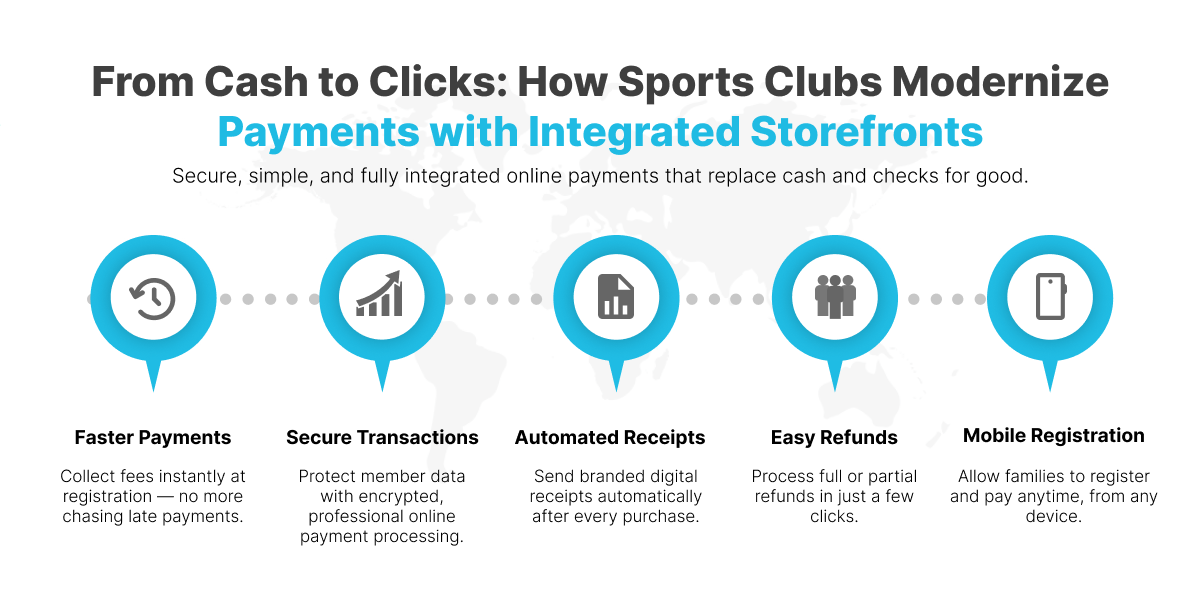
Security matters – both for protecting customer payment information and for building trust with families who are enrolling their children in your programs. Checklick’s Storefront provides secure payment processing to ensure that customers’ payment information is safe.
This is a consideration that many clubs overlook when they rely on informal payment methods. Families want to know that their financial information is handled professionally, especially when making online transactions. A branded, secure storefront communicates organizational credibility in a way that an email requesting a check simply cannot.
The Mobile Registration Experience
One of the most significant advantages of an integrated storefront is the ability for families to register and pay from their phone. The Checklick Storefront is optimized for any screen size, making it accessible on computers, tablets, and mobile phones.
This matters because many families will first encounter your programs while browsing on their phone – perhaps after hearing about your club from another parent at a game, or seeing a social media post. If they can register and pay immediately from their mobile device, the conversion from interest to enrollment is nearly instant. If they have to print a form, write a check, and deliver it in person, a significant percentage will never complete the process.
Port Dover Yacht Club experienced this directly. After implementing Checklick’s Storefront, registration became faster and more streamlined, and their new program sold out and saw high demand. When the barrier between interest and enrollment is lowered, enrollment increases.
Getting Started With Digital Payments
The transition from cash and check to digital payments does not need to be complex. Checklick’s Storefront is designed to be set up quickly, with clubs able to have a functional registration and payment system in under an hour. There are no long-term commitments – the 4.9% per-transaction model means clubs only pay when they process transactions.
Clubs can start with a 30-day free trial to test the full platform. For organizations with fewer than 50 evaluators, the $15/month evaluator package includes access to the Storefront. Managed services packages are available for larger organizations with 50 or more evaluators, including implementation specialists and consulting services.
The clubs that have made this transition consistently report not just operational improvements but also better relationships with their members. When registration is easy and payments are seamless, the entire club experience starts on a positive note.
Ready to eliminate cash and check handling? Start your 30-day free trial at www.checklick.com.
