

For most National Sport Organizations and Provincial Sport Organizations, the period between summer programs ending and fall programs beginning is one of the most operationally important windows of the year. It is when the data from summer is freshest, when affiliate clubs are between seasons and most receptive to guidance, and when year-end funding reporting cycles are beginning to come into view.
It is also, at most organizations, the period when summer program data sits unreviewed in whatever form it was collected while everyone focuses on preparing for fall.
This is a missed opportunity that compounds over time. The organizations that consistently secure the most funding, deliver the most consistent programs, and grow their affiliate networks most effectively are not the ones that collect program data. They are the ones that use it. And the window between summer and fall is when using last season’s data is most operationally valuable.
This blog covers what NSOs and PSOs should specifically be doing with their summer program data right now, before fall begins and the window of maximum utility closes. For background on the evaluation standardization that produces useful data across affiliate networks, our blog on how PSOs and RSOs can standardize athlete evaluation across all affiliated clubs covers the infrastructure that makes this possible.
The Four Things Worth Doing With Summer Program Data Before Fall
The first is a participation and completion audit across the affiliate network. Before fall programs begin, PSO and NSO administrators should pull a complete picture of summer participation across every affiliated club. Total participants by program. Completion rates by level. Demographic breakdowns by age and gender. Drop-off points where athletes did not complete the level they enrolled in.
This audit is not primarily a reporting exercise. It is a diagnostic one. Patterns in completion and drop-off data reveal where programs are working well and where they need attention. A level with consistently low completion rates across multiple clubs is not a coincidence. It is a signal that either the criteria are set too high, the program design at that level needs review, or the coaches delivering it need additional support.
Without this diagnostic view, the same problems recur season after season because nobody looked at the data carefully enough to identify them.
The second is a curriculum effectiveness review. Summer is often when programs are delivered at their highest volume with the widest range of coaches. The evaluation data from summer therefore provides the most robust test of whether the curriculum is producing the outcomes it was designed to produce.
Are athletes progressing through the skill criteria at the rate the program design assumes? Are there specific skills that athletes consistently struggle with across multiple clubs and multiple coaches? Are there skills that appear in the curriculum but that coaches rarely evaluate because they are difficult to assess in a typical session?
These questions, answered with data from the summer season, inform curriculum updates that can be implemented before fall programs begin. When PSOs and NSOs use Checklick’s Evaluation Marketplace, curriculum updates are distributed to every affiliated club simultaneously the moment they are made. There is no waiting for clubs to download a new document and implement it on their own timeline. The update is live for everyone at once.
The third is affiliate club performance review. Not every club in a PSO or NSO affiliate network delivers programs to the same standard. Summer program data, when it flows from clubs into a centralized reporting system, makes club-level performance visible in a way that manual submission processes never can.
Which clubs have the strongest completion rates? Which have the highest participant return rates from summer to summer? Which appear to be struggling with specific aspects of program delivery? This information is valuable for the PSO or NSO in deciding where to direct coaching development resources, which clubs might benefit from additional support, and which clubs are doing things well enough that others could learn from their approach.
The fourth is year-end funding preparation. For organizations that report to Sport Canada or provincial funding bodies, the summer season represents a significant portion of the annual program activity that will need to be reported. Starting the compilation of that report in August, while the data is fresh and complete, is significantly easier than starting it in November from partial records and faded memories.
Why Most Organizations Are Not Doing This
The reason most NSOs and PSOs do not make systematic use of their summer program data is not a lack of understanding that it is valuable. It is that the data is not in a form that makes systematic review practical.
When clubs submit summer data as end-of-season spreadsheet files in whatever format each club preferred, the PSO or NSO administrator faces a significant normalization task before any analysis is possible. Different clubs used different column names. Different coaches applied evaluation criteria at different thresholds. Different programs were formatted differently. Assembling a meaningful provincial picture from this collection of inconsistent files takes weeks and produces results that are too unreliable to support confident decisions.
When clubs contribute data to a centralized platform like Checklick throughout the season using standardized evaluation frameworks from the Evaluation Marketplace, the summer program data is already centralized, consistent, and reportable at the end of the season without any normalization work. A PSO administrator can pull a complete provincial summer program report with a few clicks.
The difference between these two situations is the difference between summer program data being a practical decision-making resource and being an aspiration that is too logistically complicated to actually use.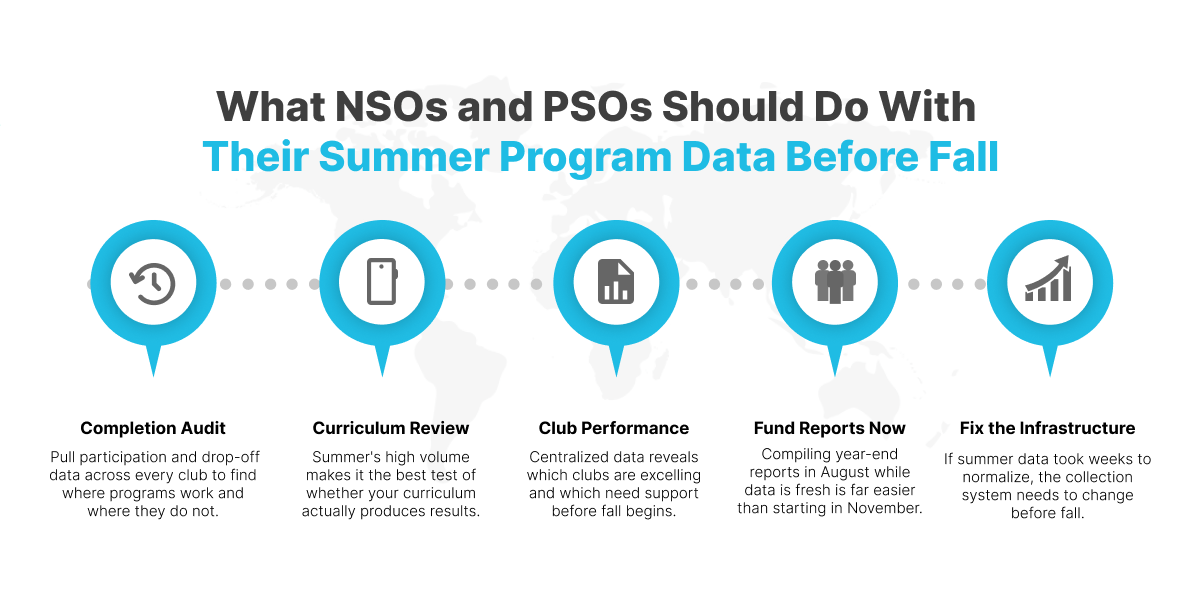
Getting the Infrastructure Right Before Fall
For organizations that are still managing affiliate data through manual submissions and email, August is a good time to evaluate whether the current approach is serving the organization’s needs or creating unnecessary friction at every reporting cycle.
Checklick’s Evaluation Marketplace allows PSOs and NSOs to distribute standardized evaluation frameworks to affiliated clubs, collect evaluation data from those clubs continuously throughout the season, and pull aggregate provincial or national reports without manual compilation. Sub-licensing allows regional partners to manage club relationships within their area.
Checklick offers a unique way to manage the licensing of programs to training centers. For PSOs and NSOs building the infrastructure that makes summer program data systematically useful, this capability is the foundation.
Frequently Asked Questions
What should NSOs and PSOs do with summer program data before fall?
Four key activities: a participation and completion audit to identify patterns across the affiliate network, a curriculum effectiveness review to inform fall program updates, an affiliate club performance review to direct support resources, and year-end funding preparation while data is fresh and complete.
How does centralized data collection change what is possible with summer program analysis?
When affiliate clubs contribute data to a centralized platform using standardized frameworks, the summer program data is already organized and comparable at the end of the season. Analysis that would take weeks of normalization work with manual submissions takes minutes with centralized data.
When is the best time to review summer program data?
Immediately after summer programs end, while the data is freshest and before fall programs begin. August is when curriculum updates can still reach coaches before fall delivery starts and when funding preparation can begin with accurate and complete data.
How does Checklick support PSO and NSO summer data review?
Checklick’s reporting tools allow PSOs and NSOs to pull aggregate program data across their affiliate networks at any point during or after the season. Participation numbers, evaluation completion rates, demographic breakdowns, and progression trends are all available without manual compilation.
Learn more and request a consultation at checklick.com.