

The Sports Club Financial Reporting Guide: What You Should Be Tracking Every Season
Most sports clubs have a treasurer. That treasurer is usually a volunteer who is doing their best with whatever tools and records the club has available. And in most cases, those tools are a combination of a bank account, a spreadsheet, and a folder full of receipts that someone will eventually get around to organizing.
This is not a criticism. It is just an accurate description of how most community sports clubs manage their finances. And for small clubs running simple programs with limited transactions, it sometimes works well enough.
But as clubs grow, as programs multiply, as registration volumes increase and revenue streams diversify, the spreadsheet-and-receipts approach starts producing results that are either always slightly wrong or always significantly delayed. The treasurer does not know the club’s real financial position until they sit down to reconcile everything, which happens quarterly if they are diligent and annually if they are busy.
By the time a financial problem becomes visible in this model, it has usually been building for months. By the time the club knows it needs to adjust, the season that created the problem is already over.
This blog covers what sports clubs should be tracking financially every season, why most clubs are not tracking it properly, and how the right tools change that without creating extra work for already-stretched volunteers.
Why Financial Clarity Matters More Than Most Clubs Admit
Financial reporting is one of those areas that most sports club administrators acknowledge is important but treat as a lower priority than the programs themselves. The programs are what the club is for. The finances are just the support structure.
This framing understates how directly financial clarity affects program quality. A club that does not know its real revenue position at mid-season cannot make confident decisions about whether to open a new program, expand an existing one, or hire an additional coach. A club that does not track which programs are generating the most revenue cannot make informed decisions about where to invest its limited resources. And a club that cannot produce clean financial records cannot build the kind of credibility with funders and sponsors that leads to external revenue beyond registration fees.
Financial clarity is not just about knowing whether the books balance at the end of the year. It is about having current, accurate information throughout the season so that the people running the club can make good decisions at the moments when those decisions matter.
What Sports Clubs Should Be Tracking Every Season
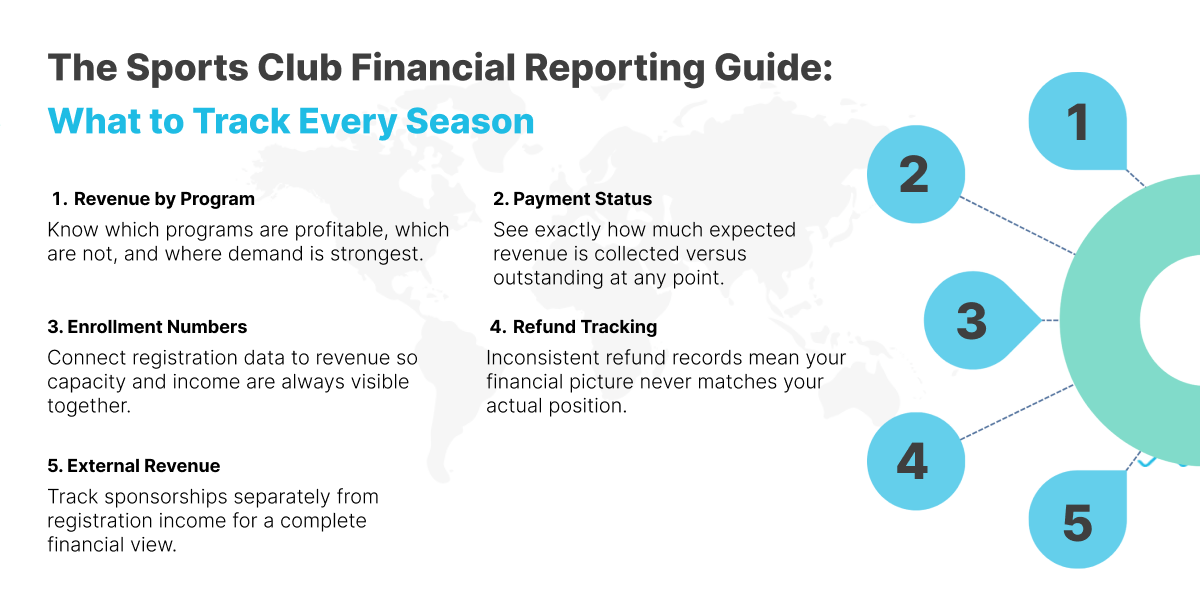
There are five financial data points that every sports club should be tracking consistently throughout the season, not just at year end.
The first is registration revenue by program. Not total registration revenue across everything the club runs, but revenue broken down by individual program. This tells you which programs are commercially viable, which are running at a loss, and where demand is strongest relative to the resources being deployed. A club that knows its per-program revenue can make much smarter decisions about which programs to grow, which to adjust, and which to reconsider.
The second is payment collection status. At any point in the season, the club should be able to see exactly how much of its expected registration revenue has been collected versus how much is outstanding. When registration and payment happen simultaneously through an online system, this is automatic. When payments are collected manually over an extended period, it requires active tracking that most clubs do not do consistently.
Gimli Yacht Club faced this problem directly before switching to Checklick. Payments were collected by cash or cheque, often not until after programs had already started. Chasing registration fees stretched well into the fall season. After moving to a system that required payment at the time of signup, that problem disappeared. With 80 participants, the club now saves roughly 20 volunteer hours per year just from removing the manual payment collection process. The financial reporting that came with the online system meant the club always knew its actual revenue position rather than having to estimate it from partial records. Read Gimli Yacht Club’s full story here.
The third is enrollment numbers by program. Enrollment data and financial data need to be connected. If a program is running at 60 percent capacity, that has direct financial implications that should be visible to the people making program decisions. If a program sold out and had a waitlist, that is equally important financial intelligence that should inform how the same program is planned the following season.
When registration is handled through Checklick’s Storefront, enrollment numbers and financial records are connected automatically. Administrators can see in real time how many participants are enrolled in each program and what revenue those enrollments have generated, without needing to cross-reference a registration spreadsheet against a payments record.
The fourth is refund and adjustment activity. Refunds are a normal part of sports club operations. Families withdraw from programs. Schedule conflicts arise. Circumstances change. How refunds are processed and tracked matters for financial accuracy. A club that handles refunds manually and records them inconsistently will always have a financial picture that does not match its actual position. Checklick’s Storefront resolved difficult refund processes for Barrie Yacht Club, which had been dealing with a previous system that made refunds and discount handling unreliable. Moving to a platform that handled these automatically improved both the accuracy of their financial records and the experience for families. Read Barrie Yacht Club’s full story here.
The fifth is sponsorship and external revenue. For clubs that have sponsors or receive funding from external sources, tracking this revenue separately from registration income provides a clearer picture of the club’s overall financial health and its dependence on each revenue stream. Barrie Yacht Club used Checklick to set up tiered sponsorship levels for external partners, adding new funding opportunities that their previous system could not support. Having a clear record of sponsorship revenue alongside registration revenue gave the club a more complete and useful financial picture.
 Why Manual Financial Tracking Always Falls Behind
The reason most sports clubs do not have accurate, current financial information is not that they do not care about it. It is that manual financial tracking is always a lagging indicator. The data you have today reflects transactions from days, weeks, or months ago, not what is happening right now.
When registration is handled by email and payments come in by cash or cheque over an extended period, the financial record is always being assembled rather than automatically maintained. Someone has to enter the data. Someone has to reconcile it against the bank statement. Someone has to cross-check it against the registration list. Each of those steps takes time and introduces the possibility of error. And each of those steps is happening after the fact rather than at the moment the transaction occurs.
When registration and payment are handled through an online platform, the financial record is maintained automatically at the moment each transaction happens. Revenue is recorded when it is collected. Enrollment numbers update when registrations are confirmed. Refunds are tracked when they are processed. The financial picture is always current because the system that generates the financial data is the same system that processes the transactions.
West Hawk Lake Yacht Club found that after switching to Checklick, financial reporting became easier and more transparent. The club went from a situation where financial clarity required manual reconciliation to one where the data was already organized and accessible. Simplified financial reporting was one of the outcomes they specifically identified after making the transition. Read West Hawk Lake Yacht Club’s full story here.
How to Get Your Financial Reporting in Order
For clubs that are currently managing finances manually, the most impactful single change is moving registration and payment onto a platform that generates financial records automatically as transactions happen.
Checklick’s Storefront does this. Every registration generates a financial record at the moment of payment. Revenue is tracked by program automatically. Enrollment numbers are connected to revenue data. Refunds and adjustments are processed through the same system. And the financial records are always current because they are updated in real time rather than assembled after the fact.
The Storefront charges 4.9% per transaction with no monthly fees, which means the cost is directly proportional to the revenue the club generates. There is no subscription to pay during the off-season. A 30-day free trial is available so clubs can see how it works before committing.
Beyond registration and payment, clubs that want more comprehensive financial reporting can use the data Checklick generates as a foundation for broader financial tracking. Revenue by program, enrollment trends, refund activity, and payment collection status are all accessible through the platform without requiring manual compilation.
Financial clarity does not require a professional bookkeeper or a complex accounting system. It requires a registration and payment platform that captures the right data automatically and makes it accessible without extra work. That is what Checklick is built to provide.
Start your free trial at checklick.com and find out how much clearer your club’s financial picture can be.