

Why Sports Clubs Lose Members After the First Season and How to Fix It
Every sports club deals with member turnover after the first season. Some families try a program, value what they experienced, and come back year after year. Others try it once, do not return, and the club never quite learns why.
This is one of the most persistent and frustrating challenges in running a sports organization because the feedback is almost never direct. Families do not usually send an email explaining their decision. They simply do not show up the following season. And because the explanation is absent, clubs tend to fill the gap with their best guess. The program was not engaging enough. The coaching was not strong enough. The fees were too high. The schedule did not work.
In most cases, these guesses are wrong. The programs are well-run. The coaches are capable and dedicated. The fees are in line with alternatives. The schedule was workable. And yet families still do not come back.
The reason is almost always something different. It is the experience that surrounded the program rather than the program itself.
What First-Season Families Are Actually Evaluating
When a family tries a sports club for the first time, they are not evaluating the coaching in isolation. They are evaluating the entire experience of being a member of your organization. And a surprisingly large portion of that evaluation is shaped by things that happen before the first session and after the last one, not during the sessions themselves.
Was registration easy to complete? Did they receive a clear, professional confirmation that their place was secured? During the season, did communication from the club arrive consistently or sporadically? Did they understand what the program was designed to achieve? Could they see how their child was developing throughout the season, or did progress feel invisible? At the end of the season, did anyone communicate clearly what came next and why it was worth continuing?
These questions get answered throughout the season, mostly without families consciously formulating them. When the answers are good, families finish the season with a clear sense of value and a natural inclination to re-enroll. When the answers are unclear or negative, they finish with a vague sense that things went fine but no compelling reason to commit to another year.
That vague sense is what drives first-season turnover. Not dissatisfaction with the program itself. Insufficient connection to the value it delivered.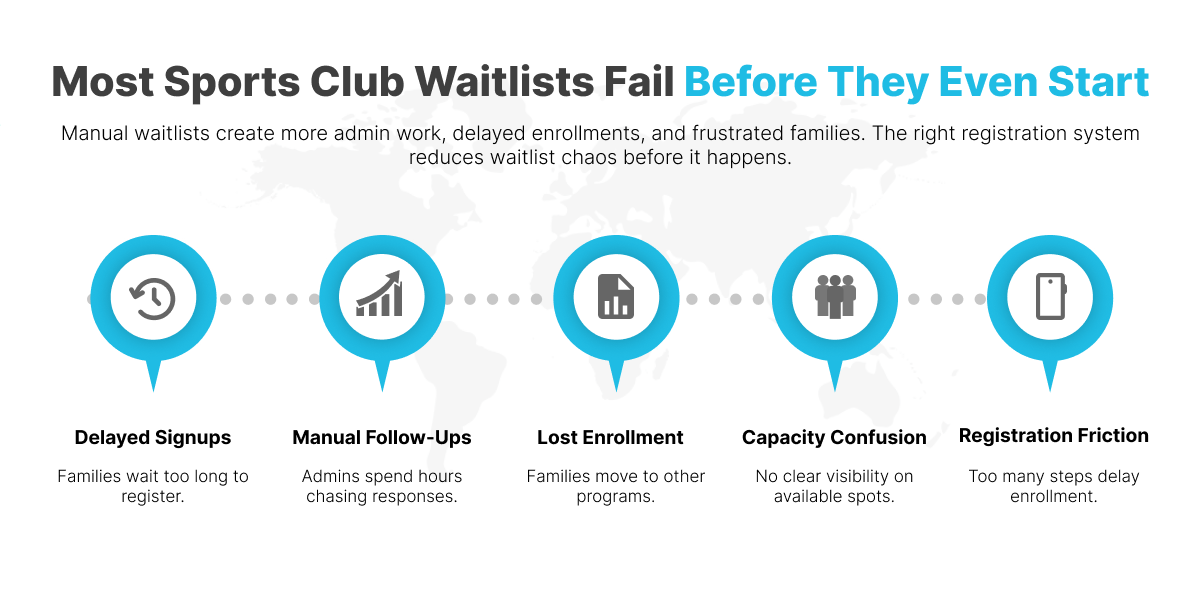 The Three Experience Gaps That Drive Early Turnover
Based on what clubs that have successfully improved their first-season retention consistently describe, three specific gaps in the member experience account for the majority of early departures.
The first gap is the registration experience. The first direct interaction a family has with your club as a paying member is the process of registering and paying. If that process involves sending an email, waiting for a response, arranging payment by cheque or cash, and then following up to confirm the registration was received and processed, it creates friction at the very start of the relationship. That friction shapes the family’s first impression of how the organization operates. It does not disappear when the season starts. It becomes part of how they think about the club. When re-enrollment comes around, that first impression is still there.
Barrie Yacht Club in Ontario had exactly this problem. Their previous registration system required cheque payments, which posed several risks including minors handling large sums of money and misplaced payments. When they moved to a different system, it introduced new problems including manual data entry, difficult refund processes, and unreliable discount handling. After transitioning to Checklick’s Storefront, registration became cleaner, faster, and more streamlined for both staff and families. The administrative burden dropped immediately. The first experience of joining the club became a professional, confirmation-complete process rather than a disorganized one.
The second gap is progress visibility. Parents who cannot see what their child is learning throughout the season have no concrete evidence of development to weigh when re-enrollment comes around. They know the season happened. They assume it probably went well because nothing went obviously wrong. But if they cannot point to anything specific their child gained from it, there is nothing concrete pulling them back for another year. The season was a black box that opened and closed without producing a clear record of what was inside it.
Port Credit Yacht Club in Ontario identified this as a core driver of their retention challenges. The club needed to retain young sailors after their first seasons and reverse a slide in adult program enrollment. Parents wanted clearer progress updates, and staff needed an easier way to provide them. Without those insights, sustaining growth and allocating resources felt like guesswork. After adopting Checklick, staff used the platform’s built-in progression displays to show parents exactly where each participant stood in the program pathway. Parents could instantly view their child’s milestones. The outcome was greater transparency for families and boosted confidence in the club’s long-term pathway. That visibility directly supported re-enrollment decisions by giving families a concrete reason to continue a development journey they could now clearly see.
The third gap is end-of-season clarity. When a season ends without a specific message about what comes next, families default to a neutral position. If the club does not communicate what the following season offers, what level the child is ready for, and why continuing is worthwhile, families make their own decision without the information they need to make it confidently. A club with a proper athlete development tracking system always has something specific to communicate at this moment. The data is in the system. Administrators know exactly where each athlete completed the season. That makes end-of-season communication targeted and forward-looking rather than generic and easy to ignore.
The Connection Between Operational Systems and Retention
The three gaps described above have something important in common. None of them are coaching problems. None of them are program quality problems. All of them are operational problems that the right infrastructure can fix without requiring additional effort from coaches or program directors.
Registration experience improves when the platform handles confirmation and communication automatically. When a family registers through Checklick’s Storefront, they receive a branded PDF receipt immediately. They know their place is secured. The relationship starts professionally. There is no need to follow up to confirm that the registration was received and processed. That automatic confirmation costs the club nothing in staff time and produces a materially better first impression.
Progress visibility improves when athlete evaluation is connected to parent communication through the same system. When a coach evaluates an athlete during a session using Checklick on their phone or tablet, that evaluation is immediately visible to parents through the platform. No report needs to be compiled. No email needs to be written. No end-of-season summary needs to be prepared. The progress information reaches parents as a natural byproduct of coaching work that is already happening. Parents see their child’s development throughout the season rather than only at the end of it.
End-of-season clarity improves when the club has actual evaluation data to communicate rather than general impressions. With Checklick, the data is already organized at the end of every season. Administrators can see exactly where each athlete completed the program, which level they are ready for next, and what the following season’s pathway looks like. That turns end-of-season outreach into a specific, evidence-based message rather than a generic re-enrollment reminder that is easy to discard.
What the Clubs That Have Fixed This Describe
Barrie Yacht Club transitioned to Checklick and found that registration became faster and more streamlined, reducing time and effort for both staff and families. The manual friction that had been shaping a poor first impression was replaced by a process that felt organized and professional from the moment a family decided to join.
Port Credit Yacht Club went further and used Checklick to directly address their retention challenge. The club offered youth learn-to-sail classes, a competitive race team, adult lessons, and a boat sharing program. They needed to retain young sailors after early seasons and reverse a slide in adult enrollment. Using Checklick’s built-in progression displays, staff could show parents exactly where each participant stood in the program pathway at any point. Custom questions in the registration flow captured how every sailor heard about the club, turning that data into actionable marketing insights. The combination of better visibility and better communication directly supported the retention outcomes the club was working toward.
One Checklick customer manages over 500 students through the platform. Sustaining that volume across multiple seasons requires exactly the kind of operational consistency that manual processes cannot deliver. Consistent registration experience. Consistent progress visibility. Consistent end-of-season communication. Each of these things requires a system rather than individual effort.
What This Means for Your Club
First-season retention is not a mystery. The clubs that retain the most members after year one are not the ones with the best facilities or the most credentialed coaches. They are the ones where joining is easy, progress is visible, and the value of the program is communicated throughout the season rather than assumed at the end of it.
These are operational decisions, not coaching decisions. They are achievable for clubs of every size and every budget. And the gap between where most clubs currently are and where they need to be is smaller than it looks from the inside.
Checklick is used by hundreds of sports clubs to manage registrations, track athlete development, and keep parents and coaches connected to what is happening in their programs. The evaluations platform starts at fifteen dollars per month for clubs with under fifty evaluators. The Storefront charges 4.9% per transaction with no monthly fees. Both come with a thirty-day free trial.
If your club is losing members after the first season and you are not sure why, the answer is probably not in your programs. It is in the experience that surrounds them. And that is something you can fix.
Start your free trial at checklick.com and see what a difference the right operational foundation makes to how families experience your club from the first day to the last.
