

How to Run a Sports Club Waitlist That Actually Works
A waitlist sounds like a good problem to have. It means your programs are popular. It means families want what your club is offering. It means you are running at capacity rather than worrying about whether there will be enough participants to make a program viable.
But if you have ever actually managed a sports club waitlist manually, you know it is not a good problem. It is a different kind of headache, one that creates its own layer of admin work, frustrates the families sitting on it, and often produces worse enrollment outcomes than a well-run registration system would have prevented in the first place.
This blog covers why most sports club waitlists break down, what actually happens to demand when the process is handled poorly, and how the right registration system makes the whole situation easier to manage and far less likely to occur.
Why Waitlists Feel Necessary But Often Are Not
The clubs that find themselves managing waitlists most often are usually dealing with one of two situations. Either their programs genuinely have more demand than capacity allows, which is a real and positive problem to solve, or their registration process is slow and inconvenient enough that families delay signing up until programs are close to full, which then creates artificial scarcity.
The second situation is far more common than most clubs realize. When registration requires emailing the club, waiting for a response, arranging payment separately, and completing a manual confirmation, the friction is high enough that interested families put it off again and again. By the time they finally commit, the program is near capacity. Late registrations compress into a short window before the season starts, creating the impression of overwhelming demand when the reality is that early demand simply was not captured efficiently.
The fix for this kind of waitlist situation is not a better waitlist management process. It is a registration system that makes it easy enough to register that families do it immediately when they decide, rather than deferring until everything else is arranged.
Why Manual Waitlists Break Down
When a popular program genuinely does fill up and families ask to be added to a waitlist, the process usually begins with good intentions. Someone records names in the order they requested. They plan to contact people as spots open.
Then a spot opens. The first family on the list is contacted. They do not respond within a day because life is busy. So the administrator waits, then follows up, then waits again. The spot sits unfilled for three or four days. Eventually the second family is reached. They say yes but the administrator now has to update the enrollment numbers, collect payment separately, send a manual confirmation, and update the class list for instructors. Then the process starts again when the next spot opens.
Multiply that by every spot that opens across every program in a season and you have a process that consumes hours of volunteer time and still produces a worse outcome for families than an automated system would deliver.
The families waiting on the list are not in a comfortable position either. They wanted to register when spots were available but missed out. Now they are in a holding pattern, unable to plan with certainty, and gradually making alternative arrangements. A waitlist is not a confirmed registration. It is conditional interest. And conditional interest weakens over time. The longer a family sits on a waitlist, the more likely they are to enroll somewhere else and turn down the spot when it finally opens.
This means waitlists often fail to convert even when spots do open. The families who wanted to come are no longer available or willing to wait. The club ends up with unfilled spots it thought were covered and a frustrated group of families who had a poor experience with the whole process.
The Real Goal Is Fewer Waitlists, Not Better Waitlist Management
The most effective strategy for almost every sports club is to minimize the need for manual waitlists in the first place. This is achievable for most clubs and it does not require any changes to program design or coaching quality. It requires three things from the registration system.
The first is opening registration early. Most families who intend to enroll their child in a summer or fall sports program make that decision weeks or months before the season starts. If your registration is open during that decision-making window, families register when they are ready. If it is not open yet, they move on and the moment passes. The clubs that consistently fill their programs before they need waitlists are the ones that have their registration live the moment the key program details are confirmed, not the moment everything is perfectly finalized.
The second is showing real-time enrollment availability. When a family visits your registration page and can see that a program has fifteen spots and eleven are already taken, the decision to register becomes urgent in a way that a general statement about limited availability never is. That visibility converts families who were planning to register soon into families who register right now. Checklick’s Storefront displays real-time enrollment availability throughout the checkout process. Enrollment limits are set per program and enforced automatically. When a program reaches capacity, it closes without anyone having to manually turn registrations away or update a number in a spreadsheet.
The third is making the checkout experience fast enough that families who decide to register complete the process immediately rather than planning to return later. Most registration abandonment in sports clubs happens not because families change their minds but because the checkout is inconvenient enough to keep getting deferred. A clean, mobile-friendly checkout where a family can select a program, fill in their details, and pay by credit card in under five minutes removes that deferral entirely. Checklick’s Storefront is optimized for any screen size, which matters because the majority of registrations happen on phones.
What Enrollment Limits Actually Do for Your Program
Setting hard enrollment limits on your programs does more than prevent overbooking. It fundamentally changes how families think about the decision to register.
A program with no visible capacity constraint feels like something that will always be available. There is no urgency to register because it never looks like spots are running out. A program with a visible limit of fifteen spots, of which eleven are already filled, feels like something that requires a decision today rather than next week.
This is not manufactured pressure. It is honest information about a real constraint. Most sports programs genuinely do have capacity limits based on instructor ratios, equipment availability, or space. Showing families that information accurately and in real time serves them as much as it serves the club.
Gimli Yacht Club used Checklick to address over-subscription problems it was experiencing with high-demand time slots. Before switching to Checklick, program organizers handled signups through email and payments were collected by cash or cheque, often not until after the program had ended. Many members would register verbally in person, making it difficult to track actual commitments. After moving to Checklick, all registrations required payment by credit card at the time of signup through a single online entry point. The system helped the club manage enrollment more effectively by preventing over-subscription to high-demand time slots. With 80 participants going through the system, the club now saves roughly 20 volunteer hours per year. Kevin Stewart, Volunteer Learn to Sail Coordinator at Gimli Yacht Club, described the change simply: no more chasing payments or sorting through emails, everything is in one place, and registration is stress-free.
Port Dover Yacht Club used Checklick’s Storefront to launch a new two-week program. The outcome was a sold-out program with high demand. Registration became faster and more streamlined, and families and staff found the process easier and more manageable than what the club had used before. The combination of a professional online checkout and clear enrollment management produced a full program without any manual waitlist management required.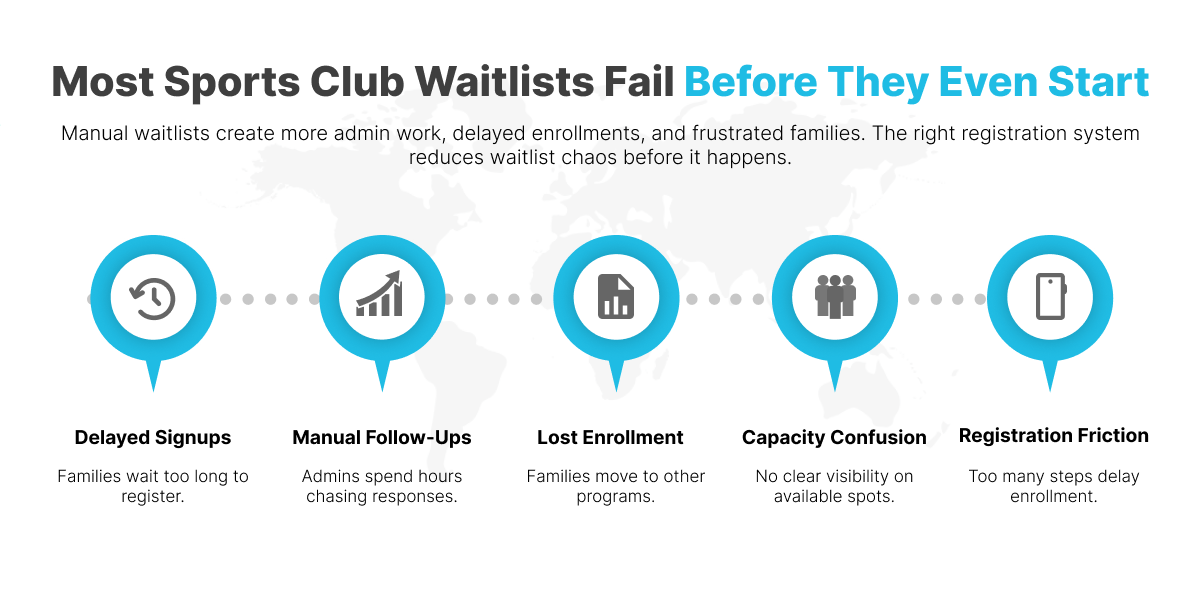
When a Waitlist Is Still Necessary
Even with the best registration system in place, some programs will fill faster than capacity allows. When that happens, a streamlined waitlist process can manage the overflow without creating significant additional burden.
The most important principle is making the waitlist process as fast and automated as possible for the administrator managing it. Families should be able to indicate their interest in being notified if a spot opens during the registration flow itself, rather than through a separate email or phone call to the club. When a spot does open, the notification should go out immediately. The window for accepting should be short and clearly stated so that spots do not sit unfilled while the administrator waits for a response.
Checklick’s custom questions feature lets clubs collect specific information during the registration flow, including whether a family wants to be contacted if capacity becomes available. Combined with the real-time enrollment tracking that shows administrators exactly where every program stands at any moment, managing a small number of overflow registrations becomes a much lighter task than maintaining a manual list across multiple email threads.
What Clubs Experience When They Get This Right
West Hawk Lake Yacht Club is a sailing organization in Manitoba that serves 30 to 50 sailors each summer. Before adopting Checklick, the club relied on paper-based methods including manually filled applications and waivers, cash registration fees, and no remote access to records. After transitioning to Checklick, the club eliminated paper forms and cash handling by moving all registrations and waivers online. Instructors received real-time access to participant lists. Financial reporting became easier and more transparent. The system helped the club keep up with growing enrollment while reducing administrative complexity.
The clubs that have the fewest waitlist problems are consistently the ones that have built registration systems designed to capture demand at the moment families are ready to commit. That means registration open early, checkout fast and mobile-friendly, enrollment limits visible and automatically enforced, and a system that handles all confirmations, receipts, and class list updates without any manual steps.
Building a Registration System That Solves the Problem Before It Starts
If your club is currently managing waitlists manually or watching programs fill up slower than the demand you know is out there, the problem is almost always in the registration process rather than in the actual level of interest.
The families are interested. They intend to register. They just keep deferring the step because the process makes it easy to defer. The right system removes that deferral by making registration easy enough to complete in the moment of decision rather than requiring a series of steps that get spread across days or weeks.
Checklick’s Storefront is built exactly for this. No monthly fees. 4.9% per transaction. Phone and email support including weekends so help is available when your programs and your registration periods are actually running. A 30-day free trial so you can see how it works before committing to anything.
Start your free trial at checklick.com and see how quickly your registration can start capturing the demand your programs are already generating.
