

Introduction
In Part 1 of the 2025 Checklick Coach Compensation Survey, we explored the demographics of the coaching community, including roles, locations, age distribution, and coaching experience.
In this second part, we shift our focus to the professional and financial aspects of coaching. These results provide insight into how instructors are certified, how they are compensated, and what types of programs they work within.
The analysis in this section covers:
- Coaching certifications
- Currency of pay
- Hourly coaching compensation
- Lesson structures
- Coaching audiences
- Whether pay reflects experience or qualification
- Additional benefits provided by programs
All findings are based on 234 verified responses collected through the survey.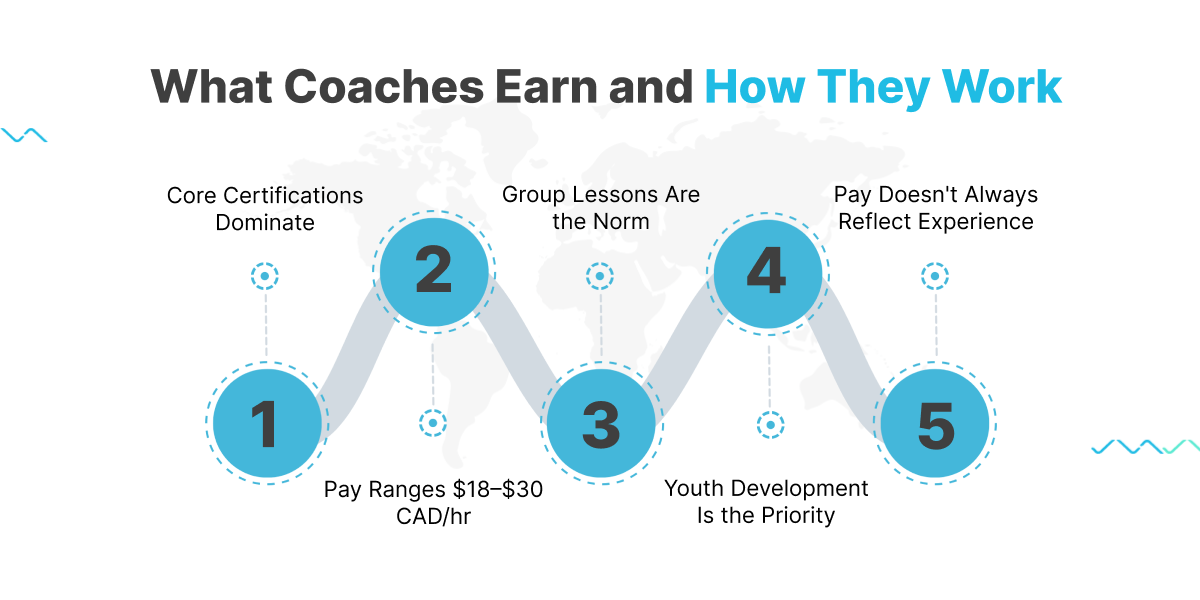
Methodology
Participants in the survey were asked a series of questions related to compensation and working conditions within coaching programs.
Respondents provided information about:
- The certification level they hold
- The currency they are paid in
- Their hourly pay for the previous season
- Whether they teach private or group lessons
- The primary audience they coach
- Whether compensation reflects qualifications or experience
- Additional benefits provided by programs
For compensation analysis, all pay values were standardized into Canadian Dollars (CAD) to ensure consistency across responses.
Responses that included volunteer roles or non-paid positions were excluded from the hourly compensation calculation to ensure that reported averages accurately reflect paid coaching roles.
The results presented below reflect the verified survey data only.
1. What Coaching Certification Do You Hold?
Respondents were asked to identify their highest coaching certification.

The results show that the majority of respondents hold either Advanced Skills Coach or Basic Skills Coach certifications, which together account for nearly three quarters of the survey responses.
These certifications represent the most common qualification levels within many sailing programs.
A smaller portion of respondents reported holding higher-level coaching roles such as Coach Evaluator or Competition Development Coach, reflecting individuals who are involved in coach development or performance-focused training programs.
2. What Currency Are You Paid In?

Respondents reported the currency used for their coaching compensation.
Most respondents reported being paid in Canadian Dollars, which aligns with the strong representation of Canadian coaching programs in the survey.
A smaller but notable portion of respondents reported being paid in Euro, reflecting participation from instructors working within European sailing programs.
A very small number of responses reported payment in U.S. Dollars.
3. What Was Your Hourly Pay for Coaching Last Season?
One of the central goals of the survey is to understand how coaches are compensated.
After standardizing all responses into Canadian Dollars, the following statistics were calculated.

Most respondents reported hourly compensation between $18 and $30 CAD per hour.
The difference between the average hourly pay ($27.41) and the median hourly pay ($23.00) indicates that a small number of higher-paid roles increased the overall average.
Median values often provide a clearer representation of the typical pay level across respondents.
4. What Lesson Type Do You Teach?
Respondents were asked about the structure of the lessons they deliver.

The majority of respondents reported teaching group lessons, which reflects the structure of many sailing programs where instructors manage multiple students during training sessions.
A significant portion of instructors reported teaching both private and group lessons, indicating flexibility within coaching roles.
Only a small number of respondents reported teaching private lessons exclusively.
5. Who Do You Teach?
The survey also asked respondents about the primary audience they coach.

Nearly half of respondents reported teaching youth programs, which highlights the central role that youth development plays in many sailing programs.
A large number of instructors also reported teaching both youth and adult students, demonstrating that many coaching roles involve working with a broad range of participants.
6. Does Your Pay Reflect Qualification or Experience?
Respondents were asked whether their pay reflects their qualifications, their experience, both, or neither.

Nearly half of respondents indicated that their pay reflects both their qualifications and experience.
However, more than a quarter of respondents reported that their compensation reflects neither factor, suggesting that pay structures may vary across different programs.
Understanding how compensation relates to experience and certification is an important factor when examining coaching workforce dynamics.
7. What Additional Benefits Are Provided?
In addition to hourly compensation, respondents reported several additional benefits offered by their programs.
The most commonly reported benefits include:

These benefits can play an important role in the overall experience of instructors working within sailing programs.
Access to equipment, training opportunities, and professional development resources can help support instructors beyond direct financial compensation.
Conclusion
The results from Part 2 of the 2025 Checklick Coach Compensation Survey provide insight into how coaching roles are structured and compensated across sailing programs.
Key findings include:
- The average hourly coaching pay was $27.41 CAD, with a median pay of $23.00 CAD.
- Most instructors reported earning between $18 and $30 CAD per hour.
- The majority of respondents hold Basic or Advanced Skills Coach certifications.
- Many instructors primarily teach group lessons and youth programs.
- Additional benefits such as equipment access and professional development opportunities are commonly provided by programs.
Together, these results provide a clearer understanding of the compensation structure and professional environment for coaches working within sailing programs.
If you’d like to better understand who today’s coaches are, Part 1 of this blog explores their roles, activity levels, locations, ages, and experience.
Read Part 1 here to learn more.
