

When you watch an Olympic athlete perform, you see the result of years of training, sacrifice, and coaching. What you do not see is everything that made that training possible: the administration that ran smoothly enough to stay out of the way. The registration systems that got athletes enrolled on time. The certification records that confirmed readiness at each stage. The coordinators who handled the logistics so that coaches could focus entirely on developing athletes.
Elite sports organizations understand that the administrative infrastructure is not separate from athlete development. It is part of it. When admin runs poorly, coaches spend their energy on paperwork instead of athletes. When registration is chaotic, families lose confidence in the program. When payment processes are slow or unclear, clubs lose revenue and credibility at the same time.
Most community sports clubs do not have the staff of an Olympic national federation. But they face many of the same administrative challenges at a smaller scale, and the impact of those challenges on program quality and club growth is just as real.
The True Cost of Disorganized Administration
The administrative problems that clubs describe most often share a common theme: they consume time that should be going elsewhere. Chasing unpaid registration fees through email. Handling cash payments at the dock or at the mat. Manually confirming enrollment numbers. Answering the same questions from families week after week because information is not accessible in a clear, centralized place.
At Gimli Yacht Club, before implementing a digital registration system, program organizers managed signups through email and collected payments in cash or by cheque, often after the program had already begun. Each registration required a manual confirmation. Members would commit verbally in person and then not follow through. Chasing down fees extended well into the fall, adding strain to volunteers who were already giving their time generously. With 80 participants, this inefficiency was adding up to roughly 20 volunteer hours per year – a significant burden for a volunteer-run organization.
This pattern is not unique to Gimli. It is the default state for clubs that have not yet invested in integrated administration tools. The good news is that the fix is straightforward.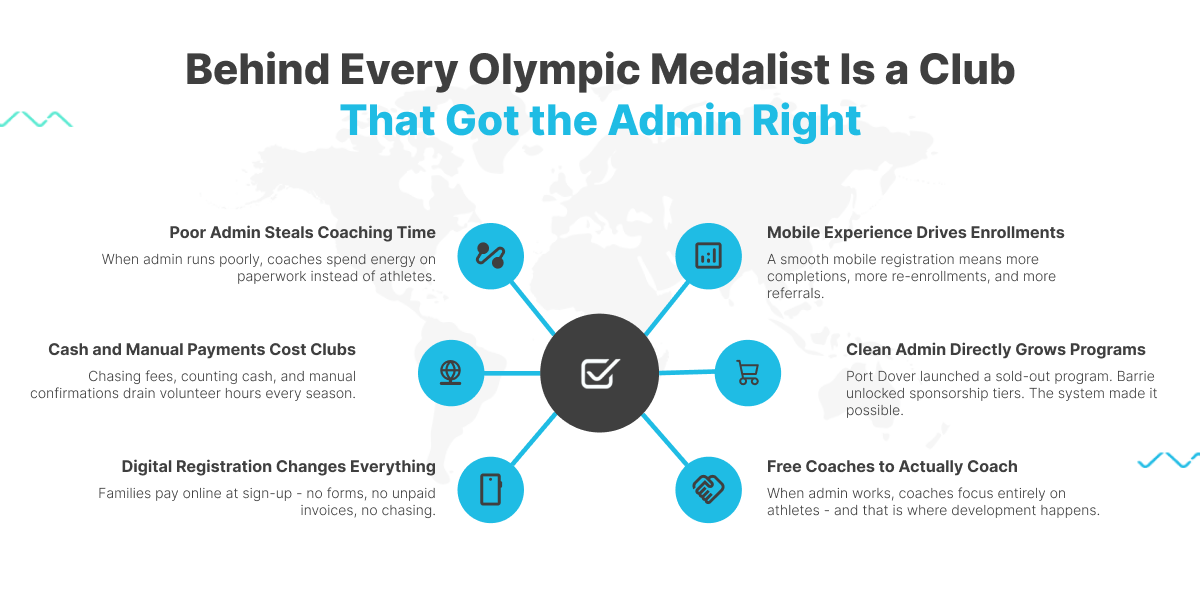
What Happens When Admin Works the Way It Should
When clubs switch to a centralized, digital registration and payment system, the changes are immediate and practical. Families register online and pay at the time of sign-up. There are no paper forms to collect, no cash to count, no unpaid invoices to chase. Enrollment limits are enforced automatically. Waiting lists manage themselves. Coordinators can see the state of every program at a glance rather than assembling the picture from multiple sources.
At Port Dover Yacht Club, the shift to digital registration and an online storefront supported the launch of a new two-week program that sold out and saw high demand. The club’s ability to manage enrollment, communicate with families, and process registrations through a single system was directly connected to that program’s success. A program that might have struggled to fill under a manual process found its audience quickly and efficiently because the infrastructure was in place to support it.
At Barrie Yacht Club, the transition away from cheque payments resolved a range of problems including payment risk, refund difficulties, and limited capacity to gather participant insights. The club also gained the ability to set up tiered sponsorship levels for external partners, opening a new funding stream that would not have been practical under the previous system.
The Mobile Experience Matters More Than Clubs Often Realize
One dimension of administrative quality that clubs sometimes underestimate is the mobile experience for participants and families. The majority of registrations and program inquiries happen on phones. A registration process that is optimized for desktop but difficult to navigate on a mobile screen creates friction that costs clubs enrollments they never know they lost.
At West Hawk Lake Yacht Club, mobile usability improvements that came with the platform transition led to fewer participant complaints about the registration process. This is a small detail with a significant downstream effect: families who have a smooth registration experience are more likely to complete enrollment, more likely to re-enroll the following season, and more likely to recommend the club to others.
Checklick’s storefront is optimized for any screen size, including computers, tablets, and mobile phones. Branded PDF receipts are automatically emailed to every customer. Customers can make purchases for multiple people and multiple products in a single transaction. These are not luxury features. They are the baseline that participants have come to expect from any well-run program.
Giving Coaches the Space to Actually Coach
The most important outcome of getting administration right is what it frees up. When coaches are not handling cash, managing enrollment spreadsheets, or answering administrative questions from families, they coach. They spend more time on instruction, more time on individual athlete development, and more time on the things that actually differentiate a good program from a mediocre one.
This is the connection that links clean administration directly to athletic development. The Olympic athletes we watched in Milan-Cortina had coaches who could focus entirely on them. Community club athletes deserve the same thing, in proportion to the club’s scale. Building the administrative infrastructure that makes that possible is not a back-office project. It is a program quality investment.
Checklick’s integrated storefront charges 4.9% per transaction with no long-term commitments. Clubs can sell courses, memberships, event tickets, and merchandise, set enrollment limits, include waiver forms, offer discounts, and configure taxes from a single platform. The evaluator plan for clubs with fewer than 50 evaluators is $15 per month. Both features are available from day one of the 30-day free trial.
Every Olympic medalist had a club behind them that ran well enough to let them develop. Your club can be that club for the athletes it serves – not by matching Olympic resources, but by building the administrative foundation that lets your program do what it is there to do.
Simplify your club’s registration, payments, and admin with Checklick. Start free for 30 days at checklick.com.
